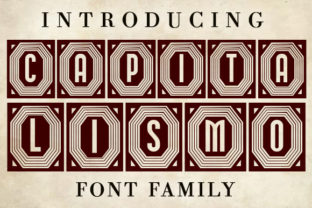
Capitalismo: A Bold Capital Font Family
If you’ve ever struggled to find a typeface that commands attention without sacrificing clarity—or one that works equally well on a conference slide, a product label, or a minimalist blog header—you’ll appreciate what Capitalismo brings to the table. It’s not just another all-caps font. It’s a thoughtfully engineered capital font family designed for impact, legibility, and versatility—offering 13 distinct variants that cover everything from delicate fine-line elegance to heavy, architectural presence.
More Than Just Uppercase Letters
Capitalismo is built exclusively with uppercase characters—but that’s where its simplicity ends. Each weight and width was crafted with optical consistency in mind. Unlike many all-caps fonts that feel cramped or monotonous at small sizes, Capitalismo maintains strong x-height proportions, open counters, and carefully tuned spacing across all variants. That means it remains highly legible even at 14px in UI elements or tightly packed navigation bars.
The family includes seven weights (Thin through Black), each with matching Italics—and two condensed widths (Condensed and Extra Condensed). That’s 13 total styles, all sharing the same underlying design language. No mismatched stroke contrast, no inconsistent terminals, no awkward scaling surprises. What you see in Light behaves predictably when you switch to Bold or Condensed—it’s unified, not assembled.
Where Capitalismo Fits in Real Workflows
Professionals don’t choose fonts based on aesthetics alone—they choose them based on how well they solve problems. Here’s where Capitalismo delivers tangible value:
- Branding & Identity: Startups and rebrands often need a strong, ownable typographic anchor. Capitalismo’s confident stance makes it ideal for logos, wordmarks, and brand guidelines—especially when paired with a neutral sans-serif for body text. A fintech company might use Capitalismo Black Condensed for its logo and Inter Regular for interface copy—creating hierarchy without visual conflict.
- Digital Interfaces: Designers use Capitalismo Light Italic for subtle section headers in dashboards or admin panels. Its low visual weight adds structure without competing with data. Meanwhile, Capitalismo Medium works exceptionally well for call-to-action buttons—crisp, readable, and slightly more distinctive than system defaults.
- Educational Materials: Teachers creating handouts or presentation decks benefit from Capitalismo’s clarity at a glance. Its generous letter spacing and uniform stroke rhythm reduce cognitive load—especially helpful for learners processing information quickly or those with mild dyslexic tendencies.
- Publishing & Editorial: Magazines and newsletters use Capitalismo Bold Italic for pull quotes or masthead accents. Because it’s strictly uppercase, it avoids the inconsistency of mixed-case styling—and eliminates the need to manually adjust case settings in CMS templates.
- Print & Packaging: On product labels, business cards, or exhibition signage, Capitalismo’s range lets you scale from delicate foil-stamped Thin on luxury packaging to commanding Black on outdoor banners—all while keeping brand voice cohesive.
Why Not Just Use Any All-Caps Font?
Many designers default to converting lowercase fonts to ALL CAPS—but that rarely works well. When you force a lowercase-optimized typeface into uppercase mode, you lose intended spacing, kerning pairs break down, and letters like “A”, “V”, and “W” crowd each other. Capitalismo avoids this entirely because every glyph was drawn and spaced as a capital from day one.
It also handles tight tracking gracefully. You can tighten letter-spacing by –20–30 units without sacrificing readability—a real advantage in constrained spaces like mobile app tabs or social media avatars. And unlike some geometric capitals, Capitalismo avoids cold rigidity: subtle flares on stems, gentle curve modulation, and soft terminations keep it approachable, not sterile.
Practical Tips for Getting Started
Before dropping Capitalismo into your next project, consider these realistic, field-tested recommendations:
- Start with context, not weight. Ask: Is this for screen or print? Temporary or permanent? High-detail or high-speed scanning? Capitalismo Thin shines in editorial contexts but may vanish on low-res projectors—opt for Medium or SemiBold there instead.
- Pair intentionally. Capitalismo doesn’t need a “contrast partner”—but it benefits from one. Try it with a warm humanist sans (like Lato or Poppins) or a sturdy grotesque (like Montserrat or Helvetica Now). Avoid other geometric capitals unless you’re aiming for deliberate repetition.
- Test vertical rhythm. Because Capitalismo has no descenders, line height behaves differently. In CSS, set
line-height: 1.3or higher for body-sized usage—even if the font appears compact. This prevents text blocks from feeling visually compressed. - Leverage the Italics—not as slanted versions, but as expressive variants. Capitalismo’s Italics are true obliques with refined angle and spacing adjustments. They work beautifully for subtitles, captions, or secondary messaging where you want distinction without hierarchy inversion.
- Watch licensing scope. Some vendors license Capitalismo per domain, per app, or per user. If you're a freelancer embedding it in client websites or SaaS dashboards, confirm whether your license covers redistribution or dynamic rendering.
A Font That Grows With Your Needs
What sets Capitalismo apart isn’t just its breadth—it’s how cohesively that breadth functions. You won’t hit a wall mid-project wondering, “Does this weight have an italic?” or “Will this condensed version align vertically with the rest?” The family scales cleanly across devices, formats, and roles.
For entrepreneurs building their first website, it simplifies typography decisions: pick one weight and one width, and you’re covered for headlines, CTAs, and branding. For agencies managing multiple clients, it reduces QA time—no more hunting down inconsistent fallbacks or missing glyphs. For educators preparing slides or worksheets, it removes guesswork around sizing and spacing.
And importantly, Capitalismo respects the reader. It doesn’t shout. It states. It doesn’t distract. It clarifies. In an era where attention is fragmented and interfaces compete for milliseconds of focus, that kind of quiet confidence is rare—and valuable.
If your current capital font feels like a compromise—too stiff, too weak, too inconsistent—Capitalismo is worth testing not as a stylistic upgrade, but as a functional one. Try it where clarity matters most: navigation, labeling, announcements, identity. You’ll notice the difference before you name it.