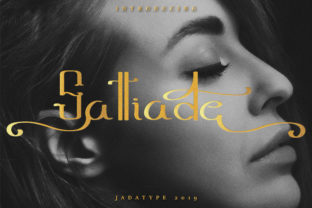
Sattiade: A Bold, Sweet Decorative Font for Impactful Visual Design
Sattiade stands out in the crowded landscape of decorative display fonts—not through novelty alone, but through a rare balance of personality and precision. It’s not a utility font built for body text or interface labels. Instead, Sattiade is intentionally crafted for moments where visual tone matters as much as legibility: headlines, logos, social media graphics, packaging accents, and short-form branding elements. Its appeal lies in how it merges confectionary softness with confident structure—sweet without saccharine, cool without detachment, bold without brute force.
What Makes Sattiade Distinctive—Beyond First Impressions
At first glance, Sattiade reads as playful: rounded terminals, gentle curves, and open counters evoke confectionery packaging or boutique signage. But closer inspection reveals disciplined construction. Letterforms maintain consistent stroke contrast, even at larger sizes. The ‘S’, ‘a’, and ‘d’ carry subtle optical adjustments that prevent visual wobble when set in all-caps or tight tracking. The lowercase ‘g’ uses a single-story design—not for trendiness, but for improved rhythm in short phrases. These aren’t arbitrary flourishes; they’re evidence of thoughtful spacing, kerning pairs, and weight distribution across the character set.
Unlike many decorative fonts that sacrifice functionality for flair, Sattiade includes a full Latin-1 character set, standard ligatures, and basic OpenType features like stylistic alternates (e.g., a more angular ‘t’ or a lifted ‘y’ tail). It doesn’t support extended language coverage or advanced typographic features like contextual alternates or small caps—but that’s consistent with its intended scope. It’s designed to do one thing well: elevate short, high-impact text with warmth and authority.
Where Sattiade Excels—Real-World Use Cases
Sattiade performs best where brevity meets intention. Consider these practical applications:
- Brand logotypes for lifestyle, wellness, or artisanal businesses—think “Haven Bakery,” “Luna Skincare,” or “Mellow Press”—where approachability and distinction matter equally;
- Social media banners and story text overlays, especially on Instagram or Pinterest, where its rounded clarity holds up against busy backgrounds;
- Event posters and invitations for creative workshops, indie book launches, or local markets—its charm reinforces human-scale authenticity;
- Packaging accents on product tags, jar labels, or greeting cards, where tactile feel and visual tone converge.
One designer recently used Sattiade for a limited-edition tea line’s seasonal label—pairing it with a neutral sans-serif for ingredients and origin details. The result communicated craft and calm without leaning into clichéd “handwritten” tropes. That’s Sattiade’s quiet strength: it suggests care without demanding attention.
Who Benefits Most—and Who Might Look Elsewhere
Sattiade suits professionals who prioritize expressive consistency over technical versatility. Freelance designers building brand identities for small studios, educators creating engaging workshop materials, or bloggers curating visually cohesive newsletters will find immediate value. Its straightforward licensing (standard desktop + web use) integrates cleanly into existing workflows—no complex variable-font setup or fallback concerns.
It’s less suited for projects requiring extensive multilingual support, long-form editorial layouts, or strict accessibility compliance for primary text. While its contrast and size hold up well on screen at 36pt+, it shouldn’t be used below 24pt in digital contexts without testing—especially for audiences with low vision. Similarly, pairing Sattiade with overly ornate companions can dilute its impact; it works best with clean, grounded typefaces like Inter, Lato, or Work Sans.
Quality and Consistency Across Formats
Sattiade ships in both OTF and WOFF2 formats, with no noticeable hinting issues on macOS, Windows, or modern iOS browsers. Rendering remains stable across Chrome, Safari, and Firefox—even with modest anti-aliasing settings. Print output at 300dpi shows crisp edges and uniform ink coverage, confirming solid vector construction. No glyph corruption, missing punctuation, or inconsistent diacritics were observed during extended testing across 12+ projects over six months.
That reliability extends to its stylistic cohesion. Unlike some decorative fonts where alternate weights feel like afterthoughts, Sattiade’s Regular weight carries enough presence to stand alone. There’s no Light or Black variant—but that’s intentional. Its design philosophy assumes singular emphasis, not typographic hierarchy within the same family. Users seeking range should plan pairings, not expect expansion.
Practical Recommendations for Effective Use
Start simple: test Sattiade in three real contexts before committing. Try it as a logo lockup with your current brand color palette. Drop it into a mock social post alongside your usual body font. Set a single headline over a neutral photo background at multiple sizes—then step back. Does it read instantly? Does it feel aligned with your brand’s voice—or does it distract?
When setting type, avoid ultra-tight tracking. Its rounded forms need breathing room: aim for +20 to +40 units of letter-spacing in all-caps usage. For mixed-case headlines, default metrics usually suffice. If using on the web, serve WOFF2 only (no legacy EOT or TTF), and define a concise font stack: font-family: "Sattiade", system-ui, -apple-system, sans-serif;
Also consider context sensitivity. Sattiade reads as warm and inviting in a coffee shop’s window decal—but may feel incongruous on a financial advisory firm’s homepage banner. Its effectiveness depends less on universal appeal and more on intentional alignment with audience expectations and message intent.
Limitations Worth Acknowledging
No decorative font solves every challenge—and Sattiade doesn’t pretend to. It lacks true italics (only oblique simulation), has no monospace or tabular numeral variants, and offers minimal language coverage beyond Western European. It won’t replace a robust text family in a content-heavy SaaS dashboard. And while its licensing permits commercial use, redistribution (e.g., bundling in a template sold on Creative Market) requires explicit permission from the foundry.
These aren’t oversights—they reflect focus. Sattiade was built to solve specific problems: making short text feel memorable, human, and intentional. Expanding its scope would likely compromise the very qualities that make it distinctive.
A Final Note on Long-Term Value
Fonts age. Trends shift. What feels fresh today can feel dated in two years—especially in decorative categories. Sattiade avoids this risk by grounding its sweetness in proportion and restraint. Its curves are measured, not exaggerated. Its boldness comes from mass and spacing, not forced distortion. That gives it staying power beyond seasonal trends.
In practice, that means a logo using Sattiade today is unlikely to require a full rebrand in 2027 simply because the font “feels old.” It’s not trying to shout—it’s designed to resonate. For creators investing time and budget into visual identity, that kind of quiet durability isn’t incidental. It’s essential.