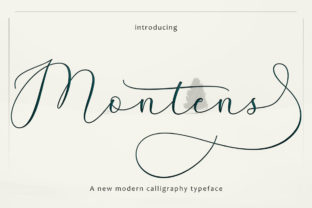
Montens: A Modern Script Font That Earns Its Place in Strategic Design
Montens isn’t just another script font—it’s a precision tool for visual communication. Designed with graceful rhythm and intentional contrast, Montens stands apart through its expressive swashes, balanced letterforms, and quiet confidence. It doesn’t shout; it invites attention with subtlety and sophistication. For professionals who understand that typography shapes perception—not just aesthetics—Montens offers real strategic leverage when used with purpose.
Why Montens Fits Into Thoughtful Branding and Communication
Typography is rarely neutral. Every font carries implicit associations: reliability, warmth, authority, playfulness, or refinement. Montens lands firmly in the refined-yet-approachable territory—ideal for brands and creators aiming to signal craftsmanship without stiffness, creativity without chaos. Its swashes aren’t decorative flourishes added for effect; they’re functional extensions of the letterform, designed to guide the eye and reinforce flow. When applied to headlines, logos, invitations, or premium packaging, Montens communicates care in execution—something customers and collaborators notice, even if unconsciously.
This matters most when consistency and clarity are at stake. A small business launching a new artisanal product line might use Montens for its logo and hero banner—but only after confirming it aligns with their core voice (e.g., “handmade,” “curated,” “timeless”). The same font would likely misfire in a tech startup’s dashboard UI or a university syllabus. Context determines value—and Montens earns its place where human-centered storytelling meets visual polish.
When Montens Delivers Measurable Value
Strategic use of Montens centers on three high-impact scenarios:
- Brand differentiation in crowded markets: In sectors like wellness, independent publishing, or boutique education, where competitors often rely on overused sans-serifs or generic scripts, Montens provides distinctiveness grounded in quality—not novelty.
- Elevating perceived value in customer touchpoints: Email headers, limited-edition print materials, or keynote slide titles gain gravitas when set in Montens—provided body text remains highly legible (e.g., paired with a neutral serif or clean sans).
- Supporting narrative cohesion across long-form content: Blog intros, ebook chapter openers, or course module headers benefit from Montens’ ability to signal transition and intention—without disrupting reading rhythm.
Notice what’s absent from this list: body copy, data tables, mobile navigation menus, or accessibility-critical interfaces. Montens isn’t built for those roles—and trying to force it there dilutes its strength while compromising usability.
How to Use Montens Intentionally—Not Automatically
Adopting Montens begins with a question: What outcome do we want this text to support? If the answer is “to stand out,” that’s insufficient. Better questions include:
- Does this headline need to convey warmth and expertise—or urgency and efficiency?
- Will readers encounter this text in a quiet, reflective context (e.g., a printed brochure) or a fast-scrolling feed?
- Is the swash enhancing meaning—or competing with it?
Practical planning starts with restraint. Limit Montens to one primary role per project: logo, hero headline, or signature element. Then define clear pairing rules—for example: “Montens only at 36pt or larger, always with Inter or Adobe Garamond for body.” This prevents visual fatigue and maintains hierarchy.
Swashes should be deployed selectively—not as default. The light swash variant works beautifully in editorial contexts where motion and elegance reinforce theme (e.g., a wedding planner’s website intro). The bold swash suits confident branding statements (e.g., “Est. 2018” beneath a boutique logo). But using both in the same layout fractures focus. Choose one expressive mode—and commit.
Risks of Using Montens Without Strategy
The most common misstep isn’t technical—it’s conceptual. Some designers install Montens, apply it liberally, and assume the aesthetic lift alone justifies its use. That approach risks three tangible outcomes:
- Mismatched tone: A financial advisor using Montens for client report covers may unintentionally signal informality over rigor—especially if the rest of the document lacks complementary structure.
- Reduced scannability: On mobile or in dense layouts, even well-designed scripts can slow comprehension. Montens shines in moments of pause—not friction.
- Brand dilution over time: When swashes appear everywhere—email footers, social bios, invoice templates—their impact fades. Distinction requires discipline.
None of these are flaws in Montens itself. They reflect gaps in alignment between font choice and strategic intent. Montens doesn’t solve communication problems—it amplifies existing clarity. Without that clarity, it simply adds visual noise.
Pairing Montens With Purpose
Effective pairing isn’t about contrast for contrast’s sake. It’s about creating harmony that serves function. Montens pairs strongest with typefaces that offer structural stability without visual dominance:
- Serif companions: Adobe Garamond, Crimson Text, or EB Garamond provide traditional balance—ideal for editorial projects, academic materials, or luxury branding where heritage and readability matter.
- Sans-serif anchors: Inter, Poppins, or Manrope deliver neutrality and scalability—making them reliable choices for digital interfaces where Montens handles emphasis and personality.
- Avoid over-engineered pairings: Fonts with extreme x-heights, tight spacing, or aggressive personality (e.g., Bebas Neue, Playfair Display Bold) often clash rather than complement. Simplicity supports Montens—not competes.
Test pairings in real contexts: paste actual headlines and body copy into mockups. View them at multiple sizes and on different devices. Does Montens still feel intentional—or merely present?
Long-Term Value Beyond First Impressions
Montens gains durability when treated as part of an evolving system—not a one-time styling decision. Consider how it performs across mediums: does the swash translate cleanly to embroidery on a tote bag? Does the light weight hold up in laser engraving on wood? These aren’t edge cases—they’re operational realities for small businesses and creators managing production themselves.
Also consider licensing scope. Montens is available in multiple weights and OpenType features—including stylistic alternates and contextual swashes. Before committing, verify your license covers web embedding, desktop use, and commercial redistribution if needed (e.g., for client deliverables or template kits). Assuming permissions can delay launches or trigger compliance issues later.
Finally, track performance—not just visually, but behaviorally. If you introduce Montens into a landing page headline, monitor bounce rate, time-on-page, and conversion alongside A/B tests. Does the font contribute to improved engagement—or is it neutral? Let evidence refine usage, not assumptions.
A Final Note on Intentionality
Great design decisions rarely come from chasing trends. They emerge from asking better questions, testing assumptions, and respecting constraints—technical, cognitive, and strategic. Montens rewards that mindset. It won’t fix weak messaging, compensate for unclear positioning, or substitute for thoughtful audience research. But when aligned with genuine goals—whether building trust with educators, elevating a handmade brand, or guiding learners through complex material—it becomes more than a font. It becomes a quiet, consistent expression of care.
So before applying Montens to your next project, pause. Clarify the goal. Define the audience. Identify the moment where attention must land—and hold. Then, and only then, let Montens do what it does best: lend grace, signal intention, and support meaning—without ever drawing attention to itself.