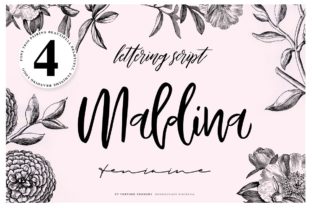
Maldina: A Modern Handwritten Font
Maldina is a thoughtfully crafted handwritten font that balances warmth and polish. It’s not just “scripty” — it’s intentionally designed with natural flow, subtle variation in stroke weight, and graceful connections between letters. What sets Maldina apart is its versatility: it comes in four distinct styles — Regular, Italic, Bold, and Bold Italic — each preserving the same organic rhythm while offering real typographic flexibility.
Why a handwritten font like Maldina matters — differently for different people
For a freelance graphic designer building a brand identity for a wellness studio, Maldina isn’t just a typeface — it’s a tone-setter. Its soft curves and unhurried rhythm suggest calm, authenticity, and care. But for a high-school teacher preparing printable classroom posters, Maldina’s legibility at medium sizes and friendly appearance help students feel welcomed, not intimidated. And for a small-batch candle maker labeling products by hand (or digitally), Maldina bridges the gap between handmade charm and professional polish — no extra design skills required.
Beginners: Clarity over complexity
If you’re new to typography or digital design tools, Maldina lowers the learning curve. Unlike some script fonts that require ligature adjustments or manual kerning, Maldina works well out of the box in Canva, Google Docs (via add-ons), Adobe Express, and even basic word processors. You can type a quote, apply the font, and immediately see something elegant — without needing to understand OpenType features or spacing rules. That immediacy builds confidence, especially when designing invitations, social media graphics, or personal journals.
Creators & marketers: Flexibility with intention
Content creators often juggle speed and consistency. With Maldina’s four styles, you can establish visual hierarchy without switching fonts: use Regular for body text in an email newsletter, Bold Italic for pull quotes on Instagram carousels, and Italic for subtle emphasis in blog posts. Marketers testing brand voice across platforms find Maldina adaptable — it reads as approachable on TikTok captions but refined enough for a printed product catalog. No need to license multiple fonts to cover tone shifts.
Educators & communicators: Legibility with personality
In educational settings, handwriting-inspired fonts can support literacy development — especially for learners who associate cursive or connected letterforms with writing fluency. Maldina avoids overly decorative loops or tight joins, making it more readable than many script fonts at 14–18pt sizes. Teachers use it for weekly classroom updates, student award certificates, or bilingual handouts where warmth reinforces inclusivity. It signals “this was made with care,” not “this was auto-generated.”
Small business owners & makers: Brand cohesion, not overhead
When you’re running a solo operation — whether selling ceramics online or managing a neighborhood tutoring service — time and budget are finite. Maldina offers commercial licensing that covers digital + print use, including merchandise and social assets. That means one purchase supports your logo lockup, packaging labels, website headers, and even client proposal PDFs — no surprise fees or tiered subscriptions. Its clean structure also scales well: it looks balanced on a tiny Instagram story sticker and remains distinctive on a 24"x36" trade show banner.
Hobbyists & lifelong learners: Joy in the details
For those using fonts as part of a creative ritual — journaling, bullet planning, calligraphy practice, or scrapbooking — Maldina invites play. The four styles let you layer textures: try pairing Bold headings with Italic subheadings in a digital planner, or alternate Regular and Italic lines in a gratitude journal. Because it’s designed with consistent x-height and spacing, mixing styles feels intentional, not chaotic. There’s no steep technical barrier — just room to experiment and feel grounded in the act of making.
What to consider before choosing Maldina
Maldina shines where human warmth matters — but it’s not meant for every context. If your project requires ultra-narrow spacing (like tight navigation menus), strict monospacing (coding interfaces), or multilingual support beyond Latin-based languages (e.g., Arabic, Devanagari), it may not be the best fit. Likewise, if your workflow depends heavily on variable font axes (like continuous weight sliders), Maldina’s fixed four-style system prioritizes simplicity over granular control.
Here’s how to check alignment with your goals:
- Ease of use? Try pasting a sentence into a free tool like Google Fonts (if available there) or your design app — does it render cleanly without missing glyphs or odd spacing?
- Commercial needs? Review the license: does it cover your intended use (e.g., client work, resale items, SaaS dashboards)? Most reputable Maldina distributors provide clear, plain-language terms.
- Creative fit? Print a sample phrase in all four styles at 24pt and 48pt. Does it hold up where you’ll actually use it — on screen, in print, or as part of a larger layout?
- Long-term value? Consider how often you’ll reach for it. A font you return to for headers, quotes, and signatures over months or years delivers more value than one used once for a trend-driven post.
Maldina doesn’t try to be everything. It excels where authenticity meets usability — in moments that benefit from a human touch, but still demand clarity and consistency. Whether you're drafting your first Canva flyer or refining a decade-old brand’s visual language, it offers a quiet kind of reliability: the kind that makes typography feel less like a technical hurdle and more like a natural extension of your voice.