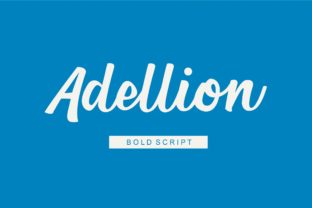
Adellion: A Bold, Standout Font for Modern Design
If you've ever spent too long scrolling through font libraries—tweaking weight, adjusting spacing, second-guessing legibility at small sizes—you’ll appreciate what Adellion offers: confidence. Not just visual confidence, but functional confidence. It’s a typeface built for impact without sacrificing clarity, and it works where many bold fonts fail—on screens, in print, across branding systems, and even in tightly constrained UI elements.
What Makes Adellion Different—Really?
Adellion isn’t “bold” in the conventional sense. It doesn’t rely on exaggerated stroke contrast or dramatic serifs to command attention. Instead, it combines geometric structure with subtle humanist warmth—notice how the lowercase a and g retain open, friendly shapes, while capitals like B and R carry clean, architectural presence. The x-height is generous, improving readability at smaller sizes, and the letterforms are carefully spaced—not overly tight, not artificially loose—so it performs well both in headlines and short body text (like captions or callouts).
Its uniqueness lies in balance: it feels contemporary but not trend-obsessed; distinctive but not distracting; expressive but never chaotic. That’s rare. Many display fonts sacrifice usability for personality. Adellion keeps both.
Where Adellion Shines—Real Use Cases
You don’t need a massive rebrand to benefit from Adellion. Its strength is adaptability across contexts most designers encounter weekly:
- Brand identity systems: Used for logotypes or submarks, Adellion adds memorability without requiring custom lettering. A boutique consultancy, a ceramic studio, or a sustainable skincare line can all use it to signal intentionality and craft—without looking like they hired a typographic consultant.
- Digital interfaces: It holds up exceptionally well in dashboard headers, app onboarding screens, and CTA buttons. Try pairing it with a neutral sans-serif (like Inter or Manrope) for body copy—Adellion handles hierarchy effortlessly.
- Educational materials: Teachers and course creators report improved student engagement when using Adellion for slide titles or worksheet headings. Its clarity reduces cognitive load, especially for neurodiverse learners or those viewing content on lower-resolution devices.
- Print collateral: Business cards, postcards, and event programs gain quiet authority with Adellion. Unlike ultra-thin or overly condensed fonts, it prints crisply—even on uncoated stock—and scales cleanly from 8 pt (fine print) to 72 pt (wall signage).
- Social content & marketing assets: Instagram carousels, LinkedIn banners, and email headers benefit from its strong rhythm and consistent color density—meaning your text won’t “fade” against busy backgrounds or get lost in thumbnail views.
Practical Considerations Before You Commit
Adellion isn’t a universal replacement for every font in your toolkit—but that’s by design. Here’s what to keep in mind before licensing or implementing it:
- Licensing scope matters. If you’re using it in client work (e.g., a website redesign or brand guide), confirm whether your license covers commercial redistribution. Some foundries offer tiered options—web-only, desktop + web, or extended for apps and merchandise.
- Test it in context—not just as a specimen. Drop Adellion into your actual Figma file or WordPress theme. Does it render cleanly across Chrome, Safari, and Firefox? Does it pair naturally with your existing body font? Don’t trust mockups alone.
- Watch vertical rhythm in long-form layouts. Because of its strong presence, Adellion can feel heavy in dense paragraphs. Reserve it for headings, pull quotes, or short labels—not full blog posts or whitepapers.
- Consider language support. The standard Adellion family includes Latin-based languages (English, Spanish, French, German, etc.), but if your audience uses extended diacritics (Polish, Turkish, Vietnamese), verify glyph coverage before finalizing.
- Load performance is solid—but not magic. As a variable font, Adellion supports axis-based adjustments (weight, width), reducing HTTP requests. Still, self-host it rather than relying on third-party CDNs if page speed is critical.
Pairing Adellion Thoughtfully
Great typography isn’t about lone stars—it’s about smart partnerships. Adellion pairs best with fonts that step back and support, not compete. Think of it as the lead vocalist: it needs backing vocals, not another frontperson.
For digital interfaces, try Inter or Roboto Flex—both offer high legibility, generous character sets, and responsive behavior. In print, Aktiv Grotesk or Ideal Sans provide complementary neutrality without visual fatigue.
Avoid pairing Adellion with other high-contrast, decorative, or ultra-narrow fonts. You’ll create tension instead of harmony. And skip monospaced fonts unless you’re intentionally going for stark, editorial contrast (e.g., tech documentation headers with code snippets underneath).
Why Designers Are Choosing Adellion—Not Just for Looks
It’s easy to choose a font because it looks “cool.” But professionals choose Adellion because it solves problems:
- Reduces revision cycles. Clients respond faster to mockups using Adellion—its clarity cuts through ambiguity. Fewer “make it bolder” or “lighter” requests mean tighter timelines.
- Strengthens voice consistency. Whether you're writing a newsletter, designing a presentation, or updating a Shopify store, Adellion delivers the same tone: grounded, intentional, quietly confident.
- Supports accessibility goals. Its open counters, consistent stroke weights, and clear letter differentiation meet WCAG 2.1 AA contrast recommendations when paired with appropriate background colors.
- Builds recognition over time. Repeated, restrained use—say, only for section headers across a year-long blog series—creates subconscious familiarity. Readers begin associating that distinct shape with your perspective or expertise.
That last point is worth underscoring: Adellion earns trust not by shouting, but by showing up reliably—clear, capable, and unmistakably itself. In an era of algorithm-driven feeds and shrinking attention spans, that kind of consistency isn’t just nice to have. It’s strategic.
A Final Note for Practitioners
If you’re evaluating Adellion for a current project, start small. Apply it to one high-impact element—your email subject line, your portfolio hero headline, your course syllabus title—and watch how users interact with it. Does it stop the scroll? Does it clarify before it decorates? Does it feel like *you*, just more focused?
That’s when you’ll know it’s not just another font. It’s a tool that aligns form and function—without asking you to compromise either.