Dingle Dangle Duo: A Thoughtful Pairing for Expressive Typography
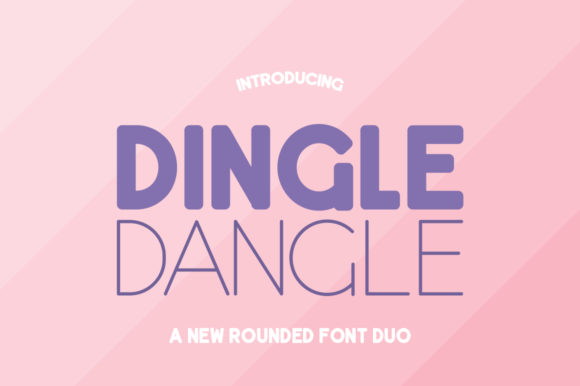
Typography choices carry weight—not just visually, but functionally and emotionally. The Dingle Dangle Duo stands out as a deliberately balanced font pairing: two distinct yet complementary typefaces designed to work together from the outset. It consists of Dingle, a bold, chunky display face with playful proportions and generous spacing, and Dangle, a refined, slender sans serif with subtle contrast and quiet elegance. Unlike many “duo” bundles that simply bundle unrelated fonts, the Dingle Dangle Duo was conceived as an integrated system—where rhythm, scale, and tone are calibrated to support each other.
What Makes This Duo Distinct—Beyond Aesthetics
The distinction lies in intentionality. Many designers cobble together headline and body fonts based on visual similarity or trend alignment—only to discover later that optical sizing, x-height ratios, or letterfit don’t harmonize across contexts. With the Dingle Dangle Duo, those variables were considered early: Dingle’s large x-height and open counters ensure legibility at small sizes (e.g., app buttons or social thumbnails), while Dangle’s taller ascenders and moderate stroke contrast provide clarity in longer paragraphs without feeling cold or mechanical.
This isn’t a monoline pairing or a strict geometric match. Instead, it embraces gentle asymmetry—Dingle leans into warmth and approachability; Dangle grounds it with restraint. That dynamic allows the duo to avoid looking overly thematic (like many novelty pairings) while still offering personality. It’s expressive without demanding attention—and flexible enough to adapt across branding, editorial layouts, packaging, or digital interfaces.
How It Fits Within Broader Typographic Strategies
When evaluating font systems, professionals often weigh three interlocking considerations: coherence, versatility, and scalability. The Dingle Dangle Duo scores strongly on coherence—the two fonts share underlying construction logic (e.g., similar terminal shapes, consistent curve tension, and compatible baseline alignment). That makes mixing them feel intuitive, not arbitrary.
Versatility is where tradeoffs emerge. Dingle excels in short-form impact: logos, posters, banners, or UI headers. It’s less suited for dense text blocks—its weight and width can fatigue readers over time. Dangle, by contrast, handles extended reading well but lacks the presence needed for dominant visual hierarchy on its own. Used separately, each has clear limits. Together, they cover more ground than either could alone—without requiring additional fonts to bridge gaps.
Scalability matters most in responsive environments. Because both fonts include multiple weights (including variable axes in some versions), designers can fine-tune contrast and emphasis across devices—reducing the need for fallbacks or overrides. That’s especially valuable when building design systems where consistency across platforms is non-negotiable.
Real-World Fit: When Does It Work Best?
The Dingle Dangle Duo shines in contexts where voice and clarity must coexist. Consider a boutique wellness brand launching a new line of herbal teas: Dingle lends friendly energy to product names (“Sunrise Chamomile”, “Midnight Mint”), while Dangle delivers clean, trustworthy ingredient lists and origin stories. Or imagine a university newsletter—Dingle introduces section headers with warmth, Dangle carries interviews and announcements without diminishing their seriousness.
It also performs well in motion graphics and micro-interactions. Dingle’s sturdy forms hold up in animation, and Dangle’s even rhythm supports smooth text transitions. That dual-strength capability is rare among pre-packaged duos, which often prioritize static use cases.
Importantly, the Dingle Dangle Duo doesn’t require stylistic compromise. It avoids the neutrality of many “safe” pairings—yet remains grounded enough for professional applications. It’s neither aggressively trendy nor stubbornly retro. That middle ground makes it viable for teams balancing creative expression with stakeholder expectations.
Where Other Options May Be More Appropriate
Not every project benefits from this balance. If your work demands extreme contrast—say, a high-fashion campaign leaning into stark minimalism or avant-garde distortion—the Dingle Dangle Duo may feel too harmonious. Similarly, highly technical documentation (e.g., API references or regulatory compliance materials) often prioritizes absolute neutrality and monospaced precision over tonal nuance. In those cases, rigorously tested monoline or coding-optimized fonts may serve better.
Projects with tight localization requirements also warrant caution. While both fonts support Latin-based languages well, coverage for extended Cyrillic, Greek, or Southeast Asian scripts varies across releases. Always verify glyph sets before committing—especially if multilingual rollout is part of the plan.
And while the duo simplifies pairing decisions, it doesn’t eliminate typographic labor. Hierarchy still requires thoughtful sizing, leading, and color contrast adjustments. Dingle’s thickness, for instance, means dark-on-light works reliably—but light-on-dark may need careful testing to preserve readability. These aren’t flaws; they’re reminders that no font solves layout strategy on its own.
Practical Comparison: Integration and Workflow
From a production standpoint, the Dingle Dangle Duo integrates cleanly into modern workflows. Both fonts are available in OpenType and variable formats, supporting CSS font-variation settings where supported. Designers using Figma or Adobe Creative Cloud report straightforward syncing and consistent rendering across platforms.
Compared to building custom pairings from disparate sources—say, combining a free display font with a premium text face—the Dingle Dangle Duo reduces licensing complexity and QA overhead. There’s no need to reconcile differing hinting, kerning tables, or vertical metrics. That saves time during handoff and reduces inconsistencies in final output.
That said, it’s not a replacement for typographic judgment. A designer might choose to supplement Dangle with a dedicated caption or footnote font in complex publications—or swap in a serif alternative for luxury-facing assets. The Dingle Dangle Duo serves best as a strong foundational layer, not an all-in-one solution.
Making the Call: Key Decision Factors
Ask yourself these questions before selecting the Dingle Dangle Duo:
- Does your project benefit from expressive warmth paired with quiet authority? If yes, the duo aligns well.
- Are you working across multiple touchpoints—print, web, video—with limited resources for custom typography? Its cross-medium reliability becomes a tangible advantage.
- Do stakeholders value distinctiveness without eccentricity? The balance here avoids polarizing reactions.
- Is linguistic scope limited to Western European languages? Confirm character support matches your audience’s needs.
- Do you already have a robust system in place—and only need one refined pairing? It slots in neatly without forcing overhaul.
Conversely, if your goal is maximal flexibility across dozens of global languages, or if your brand voice demands either extreme playfulness or unyielding austerity, other approaches—custom lettering, multi-font families, or carefully curated third-party combinations—may offer more precise control.
In the end, the Dingle Dangle Duo reflects a mature understanding of how type functions in practice: not as decoration, but as infrastructure for meaning. It doesn’t shout. It supports. And in an era where clarity and authenticity carry increasing weight, that kind of thoughtful restraint is increasingly rare—and increasingly valuable.