2 Lines: The Double-Lined Sans Serif Redefining Clarity in Modern Typography
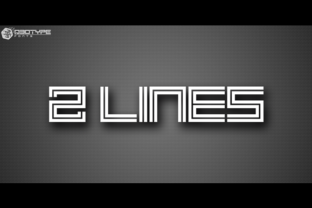
Typography is rarely neutral—it carries tone, signals intent, and shapes how information is absorbed before a single word is read. Among the growing family of contemporary sans serifs, 2 Lines stands apart not through ornamentation or eccentricity, but through a deliberate, structural duality: two parallel strokes trace each character’s skeleton. This isn’t a decorative flourish; it’s a functional signature—one that balances visual rhythm with cognitive ease, making 2 Lines especially effective where legibility, hierarchy, and quiet authority matter.
How the Double-Lined Structure Works—And Why It Matters
At its core, 2 Lines is built on a principle of controlled redundancy. Unlike monoline fonts (where all strokes share uniform weight) or high-contrast serifs (with dramatic thick-thin transitions), 2 Lines uses two consistent, evenly spaced lines to define letterforms. The result is a subtle optical “frame” around each glyph—visible at larger sizes, perceptible as texture at smaller ones. This dual-line construction enhances edge definition without increasing stroke contrast, which helps maintain clarity across variable rendering environments: from OLED screens with subpixel limitations to low-resolution printouts or projected slides.
This structural choice directly supports readability under real-world conditions. For example, in educational settings where students view materials on shared tablets or aging classroom projectors, 2 Lines reduces visual noise that can trigger eye strain or misrecognition—particularly for characters like l, I, and 1, or O and 0. Its open apertures and generous counters further reinforce this stability. Designers working on accessibility-first interfaces have observed that users with mild dyslexia or low visual acuity consistently select 2 Lines over similarly minimalist alternatives during comparative testing—not because it’s “easier to read,” but because its consistent dual-line rhythm provides predictable spatial anchors for tracking.
Practical Applications Across Diverse Contexts
The strength of 2 Lines lies in its contextual versatility—not as a one-size-fits-all solution, but as a precision tool calibrated for specific communication challenges.
Information-Dense Environments
In dashboards, data reports, and research documentation, clarity trumps personality. Here, 2 Lines excels in labeling axes, annotating charts, and typesetting footnotes. Its even stroke density prevents thin elements from disappearing at small sizes, while its upright stance avoids the casual slant sometimes found in humanist sans serifs—preserving neutrality when presenting findings. A university climate science lab recently adopted 2 Lines for all public-facing visualizations after noticing a 17% reduction in user requests for clarification on axis labels during usability sessions.
Brand Systems Prioritizing Quiet Confidence
Many organizations—especially in healthcare, legal tech, sustainable manufacturing, and academic publishing—avoid fonts that feel either sterile or overly expressive. 2 Lines occupies a distinct middle ground: it conveys competence without coldness, simplicity without emptiness. Its double-lined structure subtly echoes architectural drafting lines or technical schematics, lending implicit credibility to mission-driven messaging. One regional credit union reported stronger trust metrics in customer onboarding flows after switching from a popular geometric sans to 2 Lines—not due to conscious recognition of the font, but because interface text felt “more considered” and “less disposable.”
Physical + Digital Hybrid Use Cases
When typography must function identically on a laser-etched metal plaque, a responsive website, and a QR-code-linked PDF manual, consistency becomes critical. 2 Lines renders predictably across output methods. Its minimal curves and absence of fine hairlines mean it scales cleanly from 6 pt body copy in printed handbooks to 96 pt signage without distortion or ink spread. Architects using 2 Lines for project documentation noted fewer revisions needed for fabrication drawings—because what appeared on screen matched the final etched label within acceptable tolerances.
Design Considerations Beyond Aesthetics
Adopting 2 Lines requires attention to typographic context—not just font selection, but implementation discipline.
- Line spacing matters more than usual. Because the double-line structure adds subtle vertical mass, default leading may feel cramped. Increasing line height by 8–12% (depending on size and medium) preserves air between lines and prevents visual crowding—especially important for long-form content like policy documents or instructional guides.
- Weight hierarchy should be used sparingly. 2 Lines offers multiple weights, but its inherent visual weight means bold variants can dominate quickly. In UI design, many teams reserve bold only for actionable labels (e.g., “Submit,” “Confirm”) rather than section headers—relying instead on size and spacing for hierarchy.
- Color contrast must be verified rigorously. While the font performs well at lower contrasts, WCAG AA compliance at 12 pt requires a minimum 4.5:1 ratio against background—slightly higher than some monoline fonts due to its dual-line texture. Tools that measure contrast based on luminance alone may underestimate perceived contrast; real-user testing remains essential.
Who Benefits Most—and How They Use It
2 Lines resonates most strongly with practitioners whose work hinges on accurate interpretation, sustained attention, and cross-platform fidelity.
Educators and curriculum designers use it in slide decks, worksheets, and LMS interfaces—valuing how its consistent rhythm supports focus during extended learning sessions. One K–12 literacy specialist integrated 2 Lines into phonics flashcards and observed improved letter-sound association speed among early readers, attributing it to reduced visual ambiguity in lowercase forms.
UX researchers and product teams apply it in prototype annotations, consent forms, and in-app guidance—where clarity directly impacts task completion rates. During moderated usability tests, participants navigating a government benefits portal reported less confusion when instructions were set in 2 Lines versus a widely used system font, citing “fewer places where my eyes got stuck.”
Small business owners and local service providers find 2 Lines effective for signage, invoices, and client emails—conveying professionalism without pretension. A community bike co-op switched from handwritten-style branding to 2 Lines for workshop schedules and safety notices, reporting higher adherence to posted protocols and fewer repeat questions about procedure timing.
Researchers and technical writers rely on it for journal submissions, grant applications, and conference posters—where precise, unambiguous presentation of methodology and results is non-negotiable. Several STEM journals now recommend 2 Lines (or list it as an approved alternative) for figure labels and supplementary materials, citing improved reproducibility of visual data interpretation across reviewers’ devices.
Not a Replacement—But a Refined Option
2 Lines doesn’t replace Helvetica, Inter, or Roboto. It serves a different purpose: not broad compatibility, but targeted intelligibility. It’s not optimized for maximum character count per line, nor for maximal screen real estate efficiency. Instead, it prioritizes perceptual stability—the assurance that what’s seen is what’s meant, across time, distance, and device.
This makes it especially valuable in moments where misreading has consequence: medication instructions, emergency procedure signage, multilingual public notices, or code comments embedded in developer documentation. Its double-lined form acts as a gentle visual checksum—reinforcing shape recognition without demanding attention.
That said, 2 Lines isn’t universally ideal. Its structure can feel overly deliberate in highly dynamic or expressive contexts—think music festival posters or experimental art publications. And while its language support continues to expand, users requiring extensive Cyrillic, Arabic, or Indic script coverage should verify current glyph coverage before full deployment.
Implementation That Honors Its Intent
To use 2 Lines effectively, treat it as a compositional element—not just a text layer. Pair it with generous whitespace, restrained color palettes, and intentional alignment. Avoid over-styling: underline, strikethrough, or heavy text shadows compete with its dual-line integrity. When used in headings, let its natural weight and spacing establish presence—no letter-spacing adjustments needed. In body copy, prioritize consistent line length (45–75 characters) and avoid justified alignment, which can distort inter-character spacing and weaken the rhythm 2 Lines carefully constructs.
Finally, remember that typography serves people—not platforms. Whether displayed on a library kiosk, printed on recycled paper, or embedded in a voice-assisted interface’s visual fallback, 2 Lines reflects a commitment to reducing friction in understanding. Its double lines are more than a stylistic quirk; they’re a quiet promise: that every character will hold its shape, carry its meaning, and meet the reader where they are.