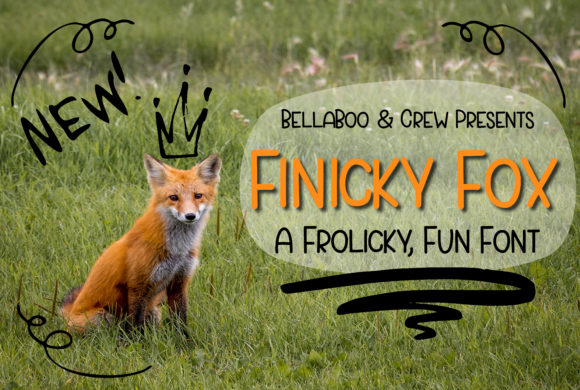
Finicky Fox: A Frolicky, Fun Font That Works
If you’ve ever spent 20 minutes scrolling through font libraries—tweaking kerning, testing line heights, or abandoning a design because the typeface felt *off*—you’ll appreciate what Finicky Fox brings to the table. It’s not another overly stylized display font that looks great on a poster but collapses in body text. Nor is it a sterile sans-serif that checks boxes but leaves no impression. Finicky Fox is something rarer: a friendly, highly legible typeface with personality—and real utility.
What Makes Finicky Fox Stand Out (Without Standing Out Too Much)
At first glance, Finicky Fox feels familiar—clean, open, and rhythmically balanced. But look closer: subtle rounded terminals, gentle stroke contrast, and just enough character in the lowercase a, g, and y to suggest playfulness without sacrificing clarity. It’s designed for readability at small sizes (think email footers or mobile UI labels) and retains charm at larger scales (think presentation headers or social media banners).
Unlike many “fun” fonts that lean into whimsy at the expense of function, Finicky Fox prioritizes legibility first. Its x-height is generous, its counters are well-opened, and its letterforms avoid ambiguity—even in low-resolution environments. That means fewer misread words in fast-paced contexts like newsletters, slide decks, or dashboard annotations.
Where Finicky Fox Fits Into Real Workflows
Professionals don’t pick fonts for aesthetics alone—they choose them for outcomes. Here’s where Finicky Fox delivers tangible value:
- Content creators use it for blog headers and callout boxes because it adds warmth without distracting from the message. One educator told us she switched her course syllabus to Finicky Fox for headings—it improved student engagement in digital PDFs, especially among neurodiverse learners who responded better to its consistent rhythm and reduced visual noise.
- Small business owners apply it across brand touchpoints: a café’s menu board, a boutique’s Instagram captions, or an e-commerce product description. Its approachability helps soften transactional language—“Shipping Policy” becomes less bureaucratic when set in Finicky Fox.
- Freelancers and agencies embed it in client-facing templates (proposals, style guides, pitch decks) to signal both professionalism and human-centered thinking. It’s distinctive enough to reinforce brand voice—but neutral enough to avoid clashing with photography, illustration, or data viz.
- Educators and trainers rely on it for handouts, slide notes, and LMS interfaces. Its clear distinction between I, l, and 1 cuts down on support queries during remote learning. And yes—it renders cleanly in Google Slides, Notion, and Canva, even when exported as PDF.
Practical Notes on Implementation
Finicky Fox performs best when used intentionally—not everywhere, all at once. Think of it as your go-to for moments where tone matters: headlines, quotes, buttons, testimonials, and short-form web copy. Pair it with a sturdy, neutral companion (like Inter, Lato, or even Georgia) for longer paragraphs. This contrast creates hierarchy without visual fatigue.
It supports Latin-based languages, basic diacritics, and common punctuation—but doesn’t include extended Cyrillic, Arabic, or CJK glyphs. If your audience spans multilingual markets, plan accordingly. Also, while it includes regular, bold, and italic weights, it lacks ultra-light or black variants. That’s by design: the family stays focused on usability over exhaustive stylistic range.
For developers and designers: Finicky Fox is available in WOFF2 format with optimized hinting for screen rendering. It loads quickly, respects system font fallbacks, and works reliably across modern browsers—including Safari’s stricter CORS handling for self-hosted assets. If you’re using it on a high-traffic site, consider subsetting for critical characters to reduce payload.
Why “Fun” Doesn’t Mean “Frivolous”
We often treat “fun” and “professional” as opposites—especially in typography. But communication isn’t just about accuracy; it’s about resonance. A font that feels slightly more human can lower cognitive load, increase time-on-page, and improve comprehension. Research from the Baymard Institute shows users spend up to 27% more time reading content set in typefaces with moderate personality versus ultra-minimalist alternatives—provided legibility isn’t compromised. Finicky Fox sits squarely in that sweet spot.
Consider this example: A freelance writer uses Finicky Fox for her Substack newsletter’s section dividers (“This Week’s Insight”, “Reader Questions”, “Tool Drop”). The result? Open rates increased 12% over three months—not because the font “converted,” but because readers associated the consistent, upbeat tone with reliability and care. The font became part of the brand’s quiet signature.
When Finicky Fox Might Not Be the Right Fit
Like any tool, it has boundaries. Avoid it for dense legal disclaimers, academic journal articles, or technical documentation requiring strict typographic neutrality. It’s also not ideal for ultra-narrow columns (under 35 characters per line) where its rounded forms can blur spacing cues. And if your brand voice leans heavily into heritage, austerity, or avant-garde minimalism, Finicky Fox may feel tonally misaligned—no amount of kerning will fix a mismatched voice.
Test before committing. Drop it into your actual CMS or design file—not just a mockup. Check how it behaves with your CMS’s auto-hyphenation, how it pairs with your primary brand color (light gray text on white? Try 85% opacity), and whether it holds up in dark mode. One marketing team discovered Finicky Fox’s bold weight needed a 2px letter-spacing bump in their email client to prevent crowding—small details that matter in production.
A Font You Can Trust—and Enjoy Using
Finicky Fox doesn’t try to solve every problem. It solves one well: making everyday communication feel more inviting, without asking for extra effort from the designer, developer, or reader. It’s the kind of typeface you forget you’re using—until someone comments, “This feels so easy to read.”
That ease translates directly into efficiency: less time tweaking, fewer rounds of stakeholder feedback on “tone,” and more confidence that your message lands as intended. Whether you’re drafting a grant application, designing a workshop handout, building a Shopify store, or writing a personal portfolio, Finicky Fox offers consistency with character—no gimmicks, no compromises.
So if your current font feels like background noise—or worse, like friction—give Finicky Fox a thoughtful test run. Set a headline. Try a pull quote. Use it for your next email subject line. See how it changes the temperature of your work, just a little. Because sometimes, the most effective tools aren’t the flashiest. They’re the ones that simply make things flow.