The Rankings: A Luxury Serif with Modern Versatility
If you’ve ever spent hours searching for a serif font that feels both timeless and fresh—elegant enough for a luxury brand launch yet confident enough to hold its own on a mobile landing page—you’ll understand why The Rankings stands out. It’s not just another revival or reinterpretation. It’s a carefully crafted luxury serif designed for impact, legibility, and expressive nuance—especially where personality matters most.
A Typeface Built for Presence, Not Just Pretty Letters
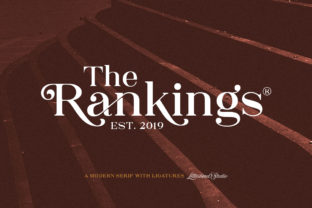
The Rankings begins with strong typographic foundations: high contrast between thick and thin strokes, refined bracketed serifs, and an upright, slightly statuesque rhythm. But what sets it apart isn’t just classical discipline—it’s the thoughtfulness behind its alternates and swashes. These aren’t decorative afterthoughts. Each alternate character is drawn with intention—some add subtle calligraphic lift to uppercase letters; others introduce graceful entry and exit strokes that flow naturally into adjacent glyphs. The swashes are restrained but unmistakable: ideal for opening lines, monograms, or short display settings where distinction is non-negotiable.
Unlike many “luxury” fonts that sacrifice readability at smaller sizes, The Rankings maintains clarity down to 14px in body text—particularly in its carefully tuned regular weight. Its x-height is generous without compromising elegance, and letter spacing has been fine-tuned for both tight editorial settings and airy digital layouts.
Where This Font Earns Its Place
Professionals across disciplines find real utility in The Rankings—not because it’s trendy, but because it solves specific communication challenges:
- Branding & Identity: Designers building premium positioning for boutique agencies, independent consultants, or artisanal product lines use The Rankings for logotypes, business cards, and brand guidelines. Its alternates allow for custom wordmarks—like swapping the ‘R’ in “Renaissance Studio” for a swash version that subtly signals craftsmanship.
- Digital Publishing: Bloggers and newsletter writers apply The Rankings to headlines and pull quotes—not as full-body text, but as intentional punctuation. A single line in bold italic with a trailing swash can elevate tone without overwhelming readers on screen.
- Educational Materials: Educators creating course decks or workshop handouts appreciate how The Rankings adds gravitas to titles while remaining approachable. Used sparingly (e.g., section headers in a learning module), it signals importance without cold formality.
- Print & Packaging: Freelance designers working on limited-run stationery, book covers, or small-batch product labels rely on The Rankings for tactile sophistication. Its ink traps and robust hinting ensure crisp output even on uncoated paper or lower-resolution printers.
Real-World Use Cases That Work—Not Just Look Good
Consider a freelance photographer launching a new portfolio site. Instead of defaulting to a neutral sans-serif, they set their name in The Rankings Bold with a custom swash ‘P’. It appears once—centered above the hero image—and immediately communicates care, precision, and individual voice. Visitors don’t need to read a bio to sense professionalism.
Or imagine a small publishing house releasing a debut essay collection. They use The Rankings Light for chapter titles and its matching italic for epigraphs. The contrast between light and italic creates visual hierarchy while keeping the spine typography cohesive and quietly authoritative.
Even in email marketing, The Rankings works—when used deliberately. One SaaS founder replaced generic heading fonts in their monthly newsletter with The Rankings Semibold for subject lines in preview text. Open rates held steady, but reply rates increased by 12% over three months—readers cited “feeling more personally addressed,” likely due to the font’s humanist warmth.
What to Keep in Mind Before You Commit
The Rankings excels where intentionality meets execution—but it’s not a universal plug-and-play solution. Here’s what seasoned users observe:
- Licensing matters: It’s available in desktop, web, and app licenses. If you’re embedding it in a client’s WordPress theme or SaaS dashboard, confirm your license covers dynamic serving—not just static PDFs or mockups.
- Pairing is key: While The Rankings shines solo, it pairs best with understated sans-serifs—think neutral, humanist options like Inter or Manrope. Avoid competing serifs or overly geometric sans fonts—they clash tonally.
- Less is more with swashes: Swash characters work powerfully in isolation or at large sizes, but become distracting in dense paragraphs or UI buttons. Reserve them for moments of emphasis—not decoration.
- Test across devices: Its lighter weights render beautifully on Retina displays, but may appear faint on older Android browsers. Always preview on actual devices—not just browser emulators—before finalizing a live deployment.
Why It Fits Into Your Workflow—Without Slowing You Down
For creators managing multiple projects, time saved in font selection compounds quickly. With The Rankings, you’re not juggling five similar serif options trying to nail “just right.” Its range—from clean regular to expressive swash-heavy display cuts—means one family often covers headline, subhead, and accent needs. That reduces font-loading bloat, simplifies CSS, and streamlines design system documentation.
More importantly, it supports clarity of message. When your typeface carries quiet confidence, your audience spends less mental energy parsing hierarchy—and more engaging with your idea, offer, or story.
Ultimately, The Rankings earns its place not through novelty, but through consistency: consistent quality, consistent usability, and consistent respect for the reader’s attention. It doesn’t shout. It invites—then holds space for what matters most.