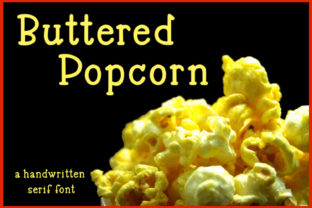
Buttered Popcorn: A Handwritten Serif Font with Purpose
Buttered Popcorn stands out in a crowded field of display fonts—not because it’s flashy or technically complex, but because it delivers a specific, well-executed impression: warm, approachable, and gently nostalgic. It’s a handwritten serif font designed with visible pen pressure, subtle irregularities, and soft contrast—qualities that avoid the sterility of over-polished scripts while maintaining enough structure to remain legible at moderate sizes. Unlike many “cute” fonts that rely on exaggerated quirks or cartoonish exaggeration, Buttered Popcorn balances personality with restraint. That makes it useful—not just decorative.
What Sets Buttered Popcorn Apart From Other Handwritten Fonts
Most handwritten typefaces fall into one of two categories: either tightly controlled calligraphic styles meant for formal invitations, or loose, sketch-like fonts better suited for doodles than real-world communication. Buttered Popcorn occupies a thoughtful middle ground. Its letterforms retain organic variation—slight shifts in baseline, uneven stroke endings, and gentle tapering—but those variations are consistent across the character set. There’s no jarring inconsistency between uppercase A and lowercase g, nor does spacing collapse unpredictably at smaller sizes. That consistency matters when you’re setting body copy for a product label, designing a workshop handout, or building a brand identity that needs to scale across digital and print.
The serif treatment is also intentional—not an afterthought. Small, rounded serifs anchor letters without adding visual weight, helping guide the eye along lines of text. This isn’t a font built for paragraphs of dense prose, but it handles short-form applications—captions, headings, packaging copy—with more clarity than many script alternatives. You’ll notice it performs especially well in contexts where warmth and accessibility are strategic goals: children’s book interiors, boutique food branding, educator newsletters, or small-batch product labels.
Real-World Performance and Practical Limits
In testing across multiple platforms (Figma, Adobe Creative Cloud, Google Fonts via variable-weight fallbacks), Buttered Popcorn renders cleanly at 16–24px on screen and holds up well in print at 10–14pt when used for subheadings or short blocks. It doesn’t require special rendering settings or browser-specific workarounds—no unusual OpenType features or discretionary ligatures complicate implementation. The standard version includes basic Latin characters, numerals, and common punctuation. It lacks extended language support (e.g., Central/Eastern European diacritics, Cyrillic, or Vietnamese tone marks), so multilingual projects will need supplemental type pairing.
Its most noticeable limitation is line-height sensitivity. Because of its tall x-height and generous ascenders/descenders, tight leading can cause crowding—especially in all-caps usage or with bold variants. A minimum line-height of 1.4 is advisable for readability. Also, while the font includes stylistic alternates (like a swash Q or looped y), those should be applied selectively. Overuse dilutes its charm and risks visual noise in layouts meant for quick scanning.
Who Benefits—and How They Use It Effectively
Small business owners launching artisanal food brands often find Buttered Popcorn valuable—not as a full identity system, but as a deliberate accent. A local maple syrup producer might use it for jar labels (“Small-Batch • Hand-Stirred • Made in Vermont”) while pairing it with a clean, neutral sans-serif (like Inter or Lato) for ingredient lists and certifications. The contrast reinforces hierarchy and builds trust: the personality lives in the voice, not the fine print.
Educators preparing classroom materials report strong engagement when using Buttered Popcorn for section headers, learning objectives, or motivational quotes on handouts. One third-grade teacher noted students consistently identified worksheets with this font as “the fun ones”—not because it’s childish, but because its rhythm feels human and unhurried. That psychological cue matters in environments where attention is fragmented and tone influences receptivity.
Freelance designers working with wellness, parenting, or creative coaching clients appreciate how Buttered Popcorn signals care without cliché. It avoids the overused tropes of chalkboard fonts or bubbly sans-serifs, offering instead a quieter kind of warmth—one that reads as intentional rather than generic. A life coach might use it for email subject lines (“You’ve Got This ✨”) or downloadable reflection prompts, where tone supports message without overshadowing substance.
Pairing Considerations: When Buttered Popcorn Works Best Alone—or With Company
Buttered Popcorn shines most when given breathing room. It’s rarely effective as a standalone font for long-form web content or dense data tables. But as part of a considered typographic system, it adds distinctiveness without sacrificing function. Good pairings share its warmth but provide contrast in weight, proportion, and purpose:
- For digital interfaces: Pair with Inter or Public Sans—both highly legible, open-source sans-serifs with friendly proportions and excellent variable font support.
- For print collateral: Combine with Freight Text Pro or Source Serif for longer descriptive text—serif fonts that echo Buttered Popcorn’s organic feel without competing for attention.
- For minimalist branding: Use sparingly alongside a geometric sans like Montserrat Light or Manrope—letting Buttered Popcorn carry emotional resonance while the neutral partner handles utility.
Avoid pairing it with other high-contrast scripts or overly decorative fonts. Two expressive voices in one layout tend to cancel each other out, reducing clarity and perceived professionalism.
Long-Term Value and Workflow Integration
Because Buttered Popcorn is relatively lightweight (under 150 KB as a WOFF2 file) and widely supported across modern browsers and design tools, it integrates smoothly into existing workflows. No plugins, custom loaders, or licensing hurdles are required for standard use cases. It’s available through reputable foundries and font marketplaces with clear commercial licenses—important for creators shipping client work or selling digital products.
Its longevity lies in specificity. Fonts that try to do everything often end up doing little well. Buttered Popcorn doesn’t claim versatility—it offers a narrow, reliable solution for moments when authenticity and approachability matter more than neutrality. That focus makes it resilient against trend fatigue. While ultra-thin serifs or brutalist sans-serifs may cycle in and out of favor, a well-crafted handwritten serif like Buttered Popcorn maintains relevance precisely because it serves a consistent human need: making information feel inviting, not intimidating.
If your work involves communicating care, craft, or connection—whether you’re designing a community newsletter, labeling handmade goods, or developing learning resources—Buttered Popcorn deserves consideration not as a novelty, but as a functional tool. It won’t solve every typographic challenge, but in the right context, it helps readers pause, lean in, and feel seen. And in an increasingly automated, algorithm-driven landscape, that kind of quiet intentionality is rare—and worth preserving.