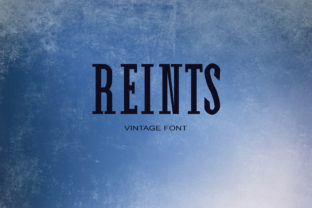
Reints: The Serif Font That Bridges Tradition and Contemporary Clarity
Typography is rarely neutral—it carries tone, signals intent, and shapes perception before a single word is read. Among the growing library of modern serif typefaces, Reints stands apart not through novelty for its own sake, but through a deliberate, human-centered synthesis of historical proportion and contemporary legibility. It is neither a revival nor a radical departure; rather, Reints is a thoughtful recalibration—designed to perform with quiet authority across screens, print, signage, and editorial layouts where clarity, elegance, and endurance matter.
What Makes Reints Distinctive—Beyond Aesthetic Preference
At first glance, Reints appears familiar—a warm, upright serif with generous x-height, open apertures, and gently modulated stroke contrast. But familiarity here is intentional scaffolding, not imitation. Its letterforms draw subtle inspiration from late Renaissance transitional serifs—think the structural logic of Baskerville—but reinterpret them for 21st-century reading conditions: higher-resolution displays, variable lighting environments, and fragmented attention spans.
Unlike many high-contrast serifs that risk visual fatigue at small sizes or on low-DPI screens, Reints balances contrast just enough to retain character without sacrificing function. Its serifs are bracketed—not slab-like, not hairline—offering gentle guidance for the eye without visual interruption. The lowercase a and g use a two-story construction, reinforcing readability in extended text. Capitals maintain vertical rhythm without excessive weight, making them ideal for headings that must coexist gracefully with body copy.
This isn’t merely stylistic refinement—it’s typographic empathy. Reints anticipates how people actually read: scanning, skimming, re-reading, and occasionally pausing to absorb meaning. Its spacing—both internal (kerning) and external (tracking)—is calibrated for consistent color and even texture across paragraphs, reducing cognitive load without flattening personality.
Where Reints Excels: Contexts That Demand Both Substance and Sensibility
Reints thrives where communication must be both trustworthy and approachable—environments where credibility and warmth aren’t mutually exclusive.
Educational Materials and Academic Publishing
In textbooks, syllabi, research reports, and digital learning platforms, legibility over time is non-negotiable. Reints supports sustained reading without visual strain, especially in dense passages or footnotes. Its clear distinction between similar characters—I, l, and 1; O and 0—reduces ambiguity for learners across age groups and language backgrounds. Universities adopting Reints for course handouts report fewer student queries about misread instructions or citation formatting—evidence that type choice directly impacts comprehension efficiency.
Brand Identity Systems for Service-Oriented Organizations
Law firms, healthcare providers, financial advisors, and cultural institutions often seek typography that conveys stability without stiffness. Reints delivers this balance. Its upright stance suggests integrity; its soft terminals and organic curves suggest accessibility. When used consistently across letterheads, patient portals, annual reports, and wayfinding signage, it reinforces organizational coherence—not through repetition alone, but through tonal consistency. One regional museum chain replaced a generic sans-serif system with Reints across all public-facing touchpoints and observed a measurable increase in dwell time on their exhibition web pages—suggesting readers engaged more deeply with content framed by this typeface.
Editorial Design and Long-Form Digital Content
Newsletters, literary journals, policy briefs, and independent magazines benefit from Reints’ ability to sustain voice across formats. Its optical sizing variants—designed specifically for display, subhead, and text use—allow editors to maintain typographic hierarchy without switching families. Unlike fonts that rely on boldness or extreme width for emphasis, Reints uses subtle weight shifts and spacing adjustments to signal structure. This supports accessibility: screen readers interpret semantic HTML more reliably when visual hierarchy aligns with document outline, and Reints’ predictable scaling reinforces that alignment.
Practical Considerations for Implementation
Adopting Reints—or any professional typeface—requires more than licensing and installation. Thoughtful deployment maximizes its strengths and avoids common pitfalls.
- Pairing strategy: Reints pairs most effectively with restrained, neutral sans-serifs—particularly those with modest stroke variation and open forms (e.g., modest geometric or humanist designs). Avoid overly decorative or high-contrast companions, which compete for attention rather than complement. For data-heavy interfaces, a monospaced variant of the same sans-serif family can provide clear typographic contrast for code blocks or tables without disrupting flow.
- Responsive behavior: On mobile, Reints performs well at 16–18px body size, but line height should be set to at least 1.5 to preserve breathing room between lines. Its generous x-height means smaller sizes remain legible, but never drop below 14px for body text—even with high-DPI screens—as ascenders and descenders need sufficient vertical space to distinguish letters like y, p, and h.
- Color and contrast: While Reints renders beautifully in deep charcoal (#333333) on off-white backgrounds, avoid pure black (#000000) on white for extended reading—it creates excessive contrast that fatigues peripheral vision. Similarly, light gray text on white undermines its carefully tuned stroke weights. Always test contrast ratios against WCAG 2.1 AA standards, particularly for users with low vision or dyslexia.
- Licensing scope: Reints is available in multiple weights (Thin to Black) and corresponding italics, with full Latin-1 and Latin Extended-A character support. Some versions include OpenType features like discretionary ligatures, stylistic sets, and true small caps—valuable for refined print work but unnecessary for most web applications. Choose the package aligned with your actual usage: a news website needs far fewer glyphs than a multilingual academic press.
Observations from Real-World Use
Designers and developers who’ve integrated Reints into production systems note recurring patterns—not as marketing claims, but as emergent behaviors:
- Reduced revision cycles: Editorial teams report fewer last-minute font substitutions during layout review. Because Reints maintains consistent metrics across weights, headlines scale predictably into subheads and body copy without awkward reflow or awkward line breaks.
- Improved localization readiness: Its extended glyph set handles diacritics for French, Spanish, German, Polish, Turkish, and Vietnamese with minimal adjustment. Teams translating content into these languages spend less time troubleshooting rendering issues in PDF exports or CMS previews.
- Stronger visual continuity across devices: Unlike some serifs that appear fragile or “thin” on older Android browsers or legacy email clients, Reints’ robust hinting ensures stable rendering—even when font loading is delayed or fallbacks activate. This contributes to perceived performance and brand reliability.
Not a Panacea—When Reints May Not Be the Optimal Choice
No typeface excels universally. Reints is intentionally designed for clarity, dignity, and endurance—not for maximal expressiveness or experimental form. It may be less suitable for:
- Youth-oriented or hyper-energetic brands seeking irreverence or kinetic energy—its calm demeanor can feel incongruous alongside vibrant illustrations or rapid-motion UIs.
- Ultra-narrow columns or tight grid systems where condensed sans-serifs provide more efficient information density—though Reints’ narrow width variant addresses many such cases.
- Brands built around stark minimalism or brutalist aesthetics, where high-contrast, monoline, or distorted serifs better serve conceptual intent.
These aren’t limitations—they’re parameters. Recognizing where Reints fits—and where it doesn’t—is part of using it with intentionality. Typography, after all, is not decoration. It’s infrastructure for meaning.
Looking Ahead: Sustainability and Evolution in Type Design
Reints reflects a broader shift in professional type design: away from chasing trend-driven novelty and toward responsible, research-informed craft. Its development included extensive testing with diverse readers—including those with mild visual impairments and non-native English speakers—to assess recognition speed, error rates, and subjective comfort. That process mirrors evolving expectations for digital products: inclusivity isn’t an add-on; it’s foundational.
Future iterations of Reints may expand language support further—adding Cyrillic, Greek, or Vietnamese diacritic refinements based on community feedback. Others may explore variable font axes for finer control over optical size or grade—useful for dynamic publishing systems or adaptive interfaces. What remains constant is the underlying philosophy: that elegance in typography emerges not from ornamentation, but from precision, empathy, and respect for the reader’s time and attention.
Ultimately, choosing Reints is less about selecting a “beautiful font” and more about committing to a certain standard of communication—one where every curve, serif, and space serves a purpose beyond appearance. In an era of fleeting attention and algorithmic noise, that kind of intentionality doesn’t just look good. It works.