Rupture Duo: Bold, Modern Font Pairing Made Simple
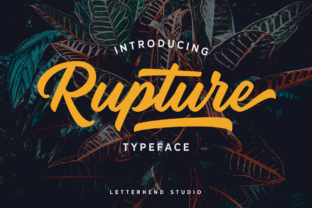
Typography isn’t just about letters—it’s about tone, clarity, and intention. When your headline needs impact but your body text demands readability, juggling two fonts that *actually* work together can eat up hours. That’s where Rupture Duo stands apart: not as two separate typefaces forced into harmony, but as a thoughtfully engineered pair—Rupture (a confident, geometric sans-serif) and its companion serif—designed from the ground up to coexist with rhythm and purpose.
Why “Pairing” Is Usually the Hardest Part
Most designers don’t struggle with finding *one* great font—they struggle with finding two that speak the same visual language without competing. You’ve probably tried pairing a bold display sans with a delicate serif only to find the contrast feels accidental, not intentional. Or you’ve defaulted to safe combinations (Helvetica + Georgia, Inter + Merriweather) because building trust in new pairings takes testing, kerning adjustments, and sometimes, outright abandonment.
Rupture Duo removes that friction. Its sans-serif carries sharp angles and generous x-heights for strong screen legibility; its serif counterpart mirrors those proportions, shares similar stroke contrast, and echoes the same structural confidence—just with serifs that guide the eye smoothly through paragraphs. The result? A pairing that feels deliberate, not assembled.
For marketers launching a campaign
A product launch landing page needs hierarchy that converts—not confuses. With Rupture Duo, your headline in Rupture commands attention at 48px, while body copy in the serif flows naturally at 18px—no line-height guesswork, no tracking tweaks needed. One client reduced time spent adjusting typography across three campaign variants from 90 minutes to under 12—because spacing, weight progression, and optical balance were already resolved in the design system.
For educators and course creators
When designing slide decks or downloadable workbooks, consistency builds credibility. Students notice when fonts shift awkwardly between title slides and bullet points. Rupture Duo offers a limited, intentional set of weights (Light, Regular, Medium, Bold for the sans; Regular and Italic for the serif), so you’re not choosing from 20 options—you’re choosing what serves the message. That restraint helps maintain focus on content, not formatting.
For small business owners updating their brand
You don’t need a full rebrand to refresh how people perceive your professionalism. Switching from generic system fonts to Rupture Duo in your website headers and email signatures adds quiet authority—without requiring logo redesigns or color palette overhauls. One local bakery reported higher perceived quality in customer surveys after updating just their menu PDF and Instagram story templates—both using the same Rupture Duo combination.
Where It Fits—and Where to Pause
Rupture Duo excels in contexts where modernity, clarity, and subtle distinction matter: digital interfaces, editorial layouts, presentation decks, packaging typography, and brand guidelines built for scalability. Its open apertures and even ink distribution make it highly legible on screens—even at smaller sizes on mobile devices.
That said, it’s not designed for ultra-narrow columns or dense legal disclaimers. If your primary use case is long-form academic publishing with strict typographic conventions—or if your audience relies heavily on screen readers and requires extended language support beyond Latin-based scripts—review its character set carefully. While it covers Western European languages comprehensively, Cyrillic, Greek, or extended Vietnamese glyphs are not included. In those cases, pairing it with a robust multilingual serif may be necessary—and worth testing early.
Creative Confidence, Not Just Visual Polish
What many users describe isn’t just improved aesthetics—it’s faster decision-making. When the relationship between headline and paragraph is pre-validated, you spend less time asking, *“Does this feel right?”* and more time asking, *“What’s the clearest way to say this?”* That shift matters most when you’re balancing multiple roles: the freelancer editing copy *and* laying out a brochure, the educator designing a syllabus *and* recording lecture slides, the founder writing a newsletter *and* approving web updates.
One freelance writer told us she stopped using font-switching plugins entirely after adopting Rupture Duo. Her process went from “try five combos, screenshot each, ask a friend” to “apply Rupture for headings, serif for quotes and captions, export.” She reclaimed roughly six hours per month—time now spent refining messaging instead of matching baselines.
Getting Started Without Overcomplicating
You don’t need advanced typography knowledge to benefit. Start with this practical sequence:
- Headlines & callouts: Use Rupture Bold (or Medium for subtlety) at sizes ≥32px.
- Body text & captions: Use the serif Regular at 16–20px, with 1.5–1.65 line height.
- Emphasis within body copy: Lean on the serif Italic—not the sans Bold—so emphasis feels integrated, not disruptive.
- Buttons & short labels: Stick with Rupture Medium or Bold in all-caps for crispness.
Avoid mixing in third fonts unless absolutely necessary. Rupture Duo gains strength from its duality—not multiplicity. Adding a third typeface often dilutes the cohesion it was built to deliver.
A Note on Licensing & Practical Use
Rupture Duo is licensed per project—not per user or seat—so whether you’re a solo blogger or part of a 12-person agency team working on one brand identity, a single license covers it. Web, desktop, and app embedding are included. There’s no subscription: you own the files, update them at your pace, and use them indefinitely. That predictability helps freelancers quote transparently and small studios avoid recurring font fees.
It also ships with OpenType features like stylistic alternates and ligatures—but these aren’t required to get great results. You can use the default glyphs and still achieve strong visual hierarchy. That accessibility-first mindset means you’re never locked into complexity to access basic functionality.
Final Thought: Typography as Quiet Infrastructure
Great tools don’t shout. They simplify. They reduce cognitive load. They let your ideas land before your audience notices the type. Rupture Duo operates like infrastructure: dependable, unobtrusive, and built to support—not overshadow—what you’re communicating. It won’t fix weak messaging or poor structure. But when those foundations are sound, it helps them resonate more clearly, consistently, and confidently—across every screen, document, and touchpoint your audience encounters.
If you’ve ever hesitated before hitting “publish” because the fonts didn’t quite *click*, or spent longer than you’d like tweaking letter spacing in a headline, Rupture Duo is worth trying—not as a trend, but as a practical step toward calmer, more intentional design work.