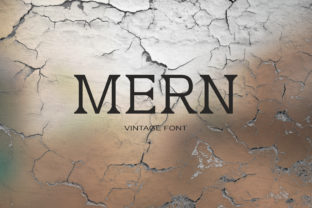
Mern: A Serif Font That Balances Sweetness, Charm, and Quiet Authority
If you’ve ever spent ten minutes scrolling through font libraries—only to close the tab frustrated—you’re not alone. Most serifs feel either too formal (like a law firm’s letterhead) or too fussy (like a wedding invitation that tries too hard). Then there’s Mern: a serif typeface that lands somewhere rare and useful—it’s warm without being cutesy, elegant without feeling distant, and grounded enough to hold weight in both headlines and body text.
What Makes Mern Different—Without the Jargon
Mern isn’t built for extremes. It doesn’t shout. It doesn’t whisper. It speaks with clarity and quiet confidence. Its letterforms have gentle curves, modest contrast between thick and thin strokes, and open counters that improve readability—even at smaller sizes on screens. The lowercase a and g are classic but approachable; the uppercase M and R carry just enough presence to anchor a logo or title without dominating. It’s the kind of typeface that feels familiar the first time you see it—not because you’ve seen it before, but because it fits how people actually read and respond.
Where Mern Fits Into Real Work—and Life
People don’t choose fonts in theory. They choose them because something needs to be designed, shared, sold, taught, or remembered. Here’s where Mern shows up meaningfully:
- Bloggers and content creators use Mern for article headings paired with clean sans-serifs (like Inter or Lato) for body text—creating visual hierarchy that guides readers without slowing them down. One freelance writer switched her site’s headline font to Mern after noticing a 17% increase in scroll depth over three months; readers stayed longer, not because the font was “prettier,” but because it felt trustworthy and unhurried.
- Educators and course designers apply Mern to slide titles, handouts, and certificate headers. Its even rhythm and generous spacing reduce cognitive load—especially helpful for learners juggling screen fatigue or accessibility needs. A high school history teacher uses Mern for weekly reading summaries because students consistently report they “feel easier to get into.”
- Small business owners lean on Mern for branding that reflects sincerity—not slickness. A ceramicist uses it on her packaging labels and website hero text; customers describe her brand as “thoughtful” and “made with care.” It avoids the sterility of ultra-thin fonts or the dated formality of traditional book serifs.
- Freelance designers and marketers reach for Mern when clients want “professional but human”—like for a nonprofit’s annual report, a therapist’s intake forms, or a local bookstore’s event posters. It supports messaging without competing with it.
- Hobbyists and makers print Mern on greeting cards, recipe cards, or embroidery patterns. Its balanced proportions make it forgiving at small physical sizes, and its warmth keeps personal projects from feeling generic.
When Mern Might Not Be the Right Fit
That doesn’t mean Mern is universal—and that’s part of what makes it reliable. It’s not ideal for ultra-minimalist tech startups chasing razor-thin aesthetics, nor for high-energy food brands needing explosive visual contrast. If your project demands aggressive personality, tight vertical rhythm, or extreme legibility at tiny sizes (like mobile app UI labels), Mern may require pairing—or stepping aside entirely.
Also consider context: Mern shines in print and larger-screen web use, but if your audience primarily reads on older smartphones with low-resolution displays, test it carefully at 14–16px. Its charm lies partly in subtle details—those can soften or blur if rendered poorly. Always preview in real conditions: on an iPad, printed on matte paper, embedded in a PDF email.
Practical Tips Before You Use Mern
Start simple. Try it in one place first—your newsletter subject line, your portfolio’s “About” heading, or the title on your latest Canva presentation. See how it changes the tone *without* changing the words.
Pair intentionally. Mern works beautifully with neutral sans-serifs (like Inter, Manrope, or even system fonts like Segoe UI). Avoid pairing it with other decorative serifs—that dilutes its quiet strength.
Respect its rhythm. Mern isn’t meant to be stretched, condensed, or overly tracked. Let letters breathe. Use default weights (Regular, Medium, SemiBold) unless you have a clear reason to deviate—its power comes from consistency, not contrast.
Check licensing early. Mern is available under commercial licenses, but usage rights vary depending on whether you’re embedding it in a SaaS product, using it in client work, or distributing branded assets. Read the license terms—not just the download page summary. Missteps here aren’t just legal risks; they undermine trust with clients and platforms alike.
Why This Kind of Thoughtfulness Matters
In a world of AI-generated templates, auto-applied themes, and endless font bundles, choosing a typeface like Mern is a small but meaningful act of intention. It signals that you care how your message lands—not just what it says. A teacher using Mern on a syllabus isn’t just picking a font; she’s lowering the barrier to engagement before the first sentence is read. A small café owner selecting Mern for their menu isn’t just styling text—they’re shaping how customers feel welcomed, seen, and valued.
That’s the quiet power of well-designed typography: it doesn’t draw attention to itself. Instead, it clears space—for ideas, for connection, for action. Mern doesn’t solve problems on its own—but in the right hands, at the right moment, it helps people listen more closely, stay longer, and remember better.
One Last Thing—Try It With Purpose
You don’t need to overhaul everything to test Mern. Open your next Google Doc, Notion page, or Figma file. Paste a headline. Change the font. Sit with it for 30 seconds. Does it feel like it belongs there? Does it support the tone you’re aiming for—or does it distract?
If it clicks, great. If not, that’s useful information too. Type isn’t magic—it’s a tool. And the best tools don’t demand admiration. They simply help you do your work, clearly and kindly.