Loredana: A Handwritten Font That Balances Personality and Practicality
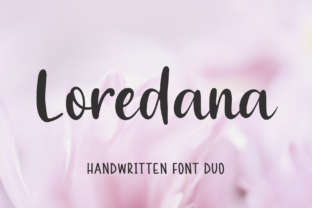
Loredana is a carefully crafted handwritten font designed to evoke warmth, authenticity, and subtle elegance. Unlike many script fonts that lean heavily into ornate flourishes or rigid calligraphic structure, Loredana strikes a middle ground—its letterforms flow naturally, with gentle variation in stroke weight and rhythm that mimics real pen-on-paper movement. It’s not overly formal, nor is it casual to the point of informality; instead, it occupies a versatile space where personality meets legibility.
What Sets Loredana Apart From Other Handwritten Fonts
Handwritten fonts fall across a wide spectrum—from tightly spaced, ultra-thin scripts ideal for luxury branding to bold, bouncy styles suited for children’s products or social media graphics. Loredana sits comfortably in the mid-range: its lowercase letters feature soft entry and exit strokes, modest ascenders and descenders, and consistent but not mechanical spacing. This makes it more readable at smaller sizes than highly decorative alternatives, while still retaining expressive character at larger display sizes.
One distinguishing trait is its intentional restraint. Many handwritten fonts rely on alternate characters, swashes, or contextual ligatures to create visual interest—but Loredana uses fewer of these features by design. Its standard character set delivers strong typographic voice without requiring deep OpenType expertise or layout adjustments. That simplicity supports faster implementation across platforms, especially when working within constraints like email templates, CMS editors, or basic design tools.
Where Loredana Fits in Real-World Design Workflows
Loredana works well in contexts where human connection matters—think wedding invitations, artisanal product packaging, boutique brand identities, or personal blog headers. Its tone feels approachable yet considered, making it appropriate for audiences who value craftsmanship and sincerity over trend-driven aesthetics.
For example, a small-batch coffee roaster might use Loredana for their label subtitle (“Roasted with care in Portland”) alongside a clean sans-serif for the main brand name. The contrast reinforces both credibility (via the neutral typeface) and warmth (via Loredana). Similarly, a freelance illustrator promoting online workshops could apply Loredana to course titles or testimonial quotes—adding tactile nuance without compromising clarity on mobile screens.
It’s less effective in environments demanding high information density or strict accessibility standards. While legible at 16–18px in headings, Loredana isn’t optimized for body text. Its connected script style reduces scanability in long paragraphs, and its lack of true italics or bold weights limits typographic hierarchy options. Users needing robust text styling—or those designing for users relying on screen readers—will want to pair it thoughtfully with supporting typefaces rather than depend on it alone.
Comparing Fit: When Loredana Serves Well—and When It Doesn’t
Choosing a handwritten font involves weighing expressive intent against functional needs. Loredana shines when the goal is to signal individuality without sacrificing polish. Compared to more experimental handwritten fonts—those with exaggerated bounce, irregular baseline alignment, or heavy texture—it offers greater consistency across applications. That predictability helps maintain brand cohesion across print, web, and social assets.
Conversely, if your project calls for dramatic contrast—say, a high-energy music festival poster where typography must compete with vivid imagery—Loredana may feel too subdued. Likewise, for corporate rebrands emphasizing innovation or technical precision, its handmade quality could unintentionally suggest informality where authority is preferred.
Another practical consideration is licensing and technical compatibility. Loredana is typically available as a desktop + web font bundle with standard OpenType support. It renders reliably across modern browsers and most design software, including Figma, Adobe Creative Cloud, and Canva (when uploaded). However, users working with legacy systems or older versions of Microsoft Office may encounter limited fallback behavior—especially if embedding isn’t supported or webfont loading fails. Testing across target environments remains essential.
Strengths Worth Noting
- Natural rhythm: Letters connect smoothly without forced loops or awkward joins, supporting readability in short headlines and quotes.
- Moderate contrast: Stroke variation adds visual interest without compromising screen legibility at common display sizes.
- Low learning curve: No need to toggle stylistic sets or manage multiple weights—what you see in the character map is largely what you get in use.
- Cross-format stability: Performs consistently whether used in static PDFs, responsive websites, or exported social graphics.
Tradeoffs to Keep in Mind
- Limited typographic hierarchy: Absence of bold, italic, or condensed variants means designers must rely on size, color, or pairing to establish emphasis.
- Not built for extended reading: Best reserved for titles, pull quotes, logos, or short labels—not paragraph text or data-heavy interfaces.
- Subtle, not commanding: May fade into the background in visually busy layouts unless deliberately isolated or paired with strong negative space.
- Cultural neutrality: While legible internationally, its aesthetic leans Western European handwriting conventions—less suited for projects requiring multilingual script support beyond Latin-based languages.
How to Evaluate Whether Loredana Aligns With Your Goals
Before committing, ask three questions rooted in your actual use case:
- What emotion or impression do you want the typography to reinforce? If “thoughtful,” “handmade,” or “intimate” fits your brand voice better than “bold,” “futuristic,” or “corporate,” Loredana is worth exploring.
- Where will this font appear—and at what scale? Test it in context: as a logo lockup, a hero section headline, a product tagline, or an email subject line. Does it retain clarity and charm across those settings?
- What other typefaces will accompany it? Loredana pairs effectively with humanist sans-serifs (like Inter, FF Meta, or Work Sans) and some low-contrast serifs (Freight Text, Scaly). Avoid clashing with other scripts or overly geometric sans-serifs unless intentional contrast is part of the strategy.
Also consider production realities. If your team lacks time or expertise to fine-tune kerning or adjust tracking manually, Loredana’s balanced default spacing gives you a head start. But if your workflow includes frequent A/B testing of typographic treatments—or requires rapid iteration across dozens of templates—its fixed character set means less flexibility than fonts with extensive alternate glyphs.
Final Thoughts for Thoughtful Typography Decisions
Loredana isn’t a universal solution—but then, few typefaces are. Its value lies in its focused execution: a handwritten font that prioritizes usability alongside expression. It doesn’t try to be everything at once. Instead, it serves a specific, increasingly relevant need—bringing quiet humanity to digital and printed spaces without overcomplicating the process.
That makes it especially useful for independent creators, small studios, and marketing teams balancing creative goals with practical constraints. If your work benefits from warmth that doesn’t sacrifice professionalism—if you’re selecting type not just for appearance but for how it supports meaning and message—then Loredana deserves genuine consideration alongside other options.
As with any typographic choice, the best test isn’t theoretical appeal, but real-world performance: how it behaves in your layout, how it reads across devices, and how it resonates with the people you aim to reach. Try it in context before deciding—not as a standalone specimen, but as part of your actual content, hierarchy, and environment.