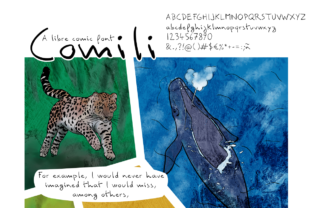
Comili: A Handwritten Comic Font with Personality
Comili isn’t just another font—it’s handwriting turned into type. Designed by an illustrator who needed text that felt like part of the drawing, Comili captures the warmth, rhythm, and subtle imperfections of real pen-on-paper script. It’s light in weight but large in presence, balancing readability with expressive charm. Whether you’re labeling a speech bubble or setting a bold chapter title, Comili bridges the gap between illustration and typography in a way few fonts do.
Why a Handwritten Font Like Comili Matters—Depending on Who You Are
What makes Comili valuable shifts depending on your role, goals, and daily tools. A freelance cartoonist sees it as a time-saver for consistent lettering. A small business owner launching a playful brand might view it as a shortcut to visual authenticity. An educator creating classroom comics for reluctant readers may value how its open shapes and generous spacing support legibility. None of these uses are “wrong”—they reflect real needs, not just aesthetic preferences.
For Creators & Illustrators
If you draw comics, zines, or illustrated stories, Comili likely feels familiar—because it was built from actual sketchbook practice. Its baseline has gentle variation, its letters connect naturally (but don’t force ligatures), and its x-height is tall enough to hold up at small sizes without losing character. Unlike many script fonts that collapse into illegibility below 24pt, Comili remains clear even in tight panel captions. Try it for hand-lettered signage in a scene, or as a unifying voice across multiple characters’ thought bubbles—no redrawing needed.
For Designers & Marketers
You don’t need to be a comic artist to benefit. Comili works well in branding where approachability matters: indie book covers, café menus, workshop handouts, or social media graphics for creative courses. Its light weight avoids visual heaviness, while its handmade quality signals care and craft—not polish-for-polish’s-sake. Pair it with a clean sans-serif (like Inter or Lato) for contrast that feels intentional, not accidental. Just avoid using it for body copy in long-form web content; its charm shines brightest in short, high-impact phrases.
For Educators & Content Makers
In learning materials—especially for younger audiences or neurodiverse learners—font choice affects engagement and comprehension. Comili’s consistent stroke width and open counters (the enclosed spaces in letters like ‘a’, ‘e’, or ‘o’) reduce visual crowding. That helps readers track lines more easily. One literacy tutor used Comili for vocabulary flashcards with hand-drawn icons, reporting improved recall compared to standard digital fonts. It’s not a replacement for dyslexia-specific typefaces, but it’s a thoughtful option when personality and clarity both matter.
For Hobbyists & Beginners
If you’re just starting with digital illustration or self-publishing, Comili lowers the barrier to professional-looking results. No need to master calligraphy or wrestle with vector paths to get expressive text. Install it, type, and go—no kerning presets or stylistic sets required. That simplicity matters when motivation is fragile and time is scarce. You’ll notice faster iteration: draft a comic page, adjust dialogue, re-export—all without switching tools or losing the handwritten feel.
What Different Users Prioritize—and Where Comili Fits
Not every font serves every need equally. Here’s how Comili aligns—or doesn’t—with common priorities:
- Ease of use: High. It’s a standard OpenType font—no special software, no cloud dependencies. Works in Affinity Designer, Procreate (with font import), Canva, Adobe apps, and most word processors.
- Flexibility: Moderate. It excels in display and short text, but lacks alternate characters, small caps, or extensive language support beyond basic Latin. Not ideal for multilingual publishing or complex typographic hierarchies.
- Creativity support: Strong. Because it mirrors natural gesture, it invites experimentation—layering, color fills, subtle drop shadows—that enhance storytelling without feeling gimmicky.
- Commercial use: Yes, with license. Check the current terms when downloading—most versions allow use in client work, merchandise, and digital products, but verify if you’re selling templates or SaaS interfaces.
- Long-term usefulness: Steady. Handwritten fonts can date quickly, but Comili’s balance of looseness and structure gives it staying power. It avoids trendy quirks (like exaggerated swashes or forced distress) that feel dated in two years.
Real Projects, Real Decisions
A freelance illustrator used Comili to unify five different artists’ contributions in an anthology zine—each kept their own drawing style, but Comili provided consistent, friendly voice for titles and credits. No one had to learn new lettering rules.
A boutique bakery added Comili to their Instagram Stories for daily specials. Followers commented that the text “felt like it was written just for them,” boosting engagement more than their previous template-based graphics.
A middle school art teacher printed Comili-based worksheets for a lettering unit. Students traced over the glyphs first, then tried mimicking the rhythm freehand—making typography tactile and accessible.
Does Comili Match Your Next Project?
Ask yourself:
- Is your project visual-first? (Comics, posters, packaging, social visuals)
- Do you want text that feels human—not generic, not robotic, not overly polished?
- Will the text appear in short bursts rather than dense paragraphs?
- Are you comfortable with a font that has personality but limited stylistic variants?
If three or more answers are yes, Comili is worth trying. If your work relies heavily on multilingual support, strict accessibility compliance (like WCAG AA for body text), or fine-grained typographic control (fractional tracking, optical sizing), look elsewhere—or pair Comili with a robust companion font for balance.
There’s no universal “best” font—only the right tool for what you’re making, who you’re making it for, and how much time you have to make it well. Comili meets a specific need with quiet confidence: helping words feel like part of the art, not an afterthought.