Adelmo: A Handwritten Font That Earns Its Place in Strategic Design
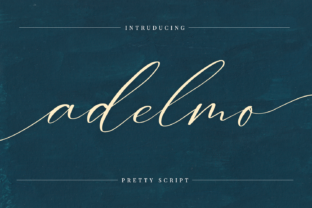
Adelmo is not just another script font. It’s a subtle, meticulously crafted handwritten typeface—rich in detail, grounded in classical calligraphy, and calibrated for intentionality. Unlike decorative scripts that prioritize flourish over function, Adelmo balances elegance with legibility, warmth with precision. Its letterforms carry the quiet confidence of ink on paper: slight variation in stroke weight, organic entry and exit terminals, and a natural rhythm that invites attention without demanding it. For professionals who choose every visual element deliberately—whether launching a brand, designing a course, or crafting a client proposal—Adelmo functions less as decoration and more as a decision-support tool.
Why Adelmo Fits Into Purpose-Driven Work
Strategic typography isn’t about aesthetics alone—it’s about alignment. When your goals involve building trust, conveying authenticity, or distinguishing yourself in saturated markets, type choices quietly shape perception before a single word is read. Adelmo supports those goals because it signals care, craft, and continuity with time-honored communication traditions. It doesn’t shout; it leans in. That makes it especially effective for audiences who value nuance: educators introducing complex ideas, consultants framing sensitive feedback, small business owners communicating values to loyal customers, or creators building intimate digital spaces.
Consider how Adelmo behaves in context. At 24–36pt, it reads beautifully in headlines, invitations, or hero sections—where tone matters as much as message. At smaller sizes (14–18pt), it holds up well in pull quotes, signature lines, or short labels—provided contrast and spacing are carefully managed. Its strength lies in restraint: it gains impact when used sparingly, not ubiquitously. That discipline mirrors sound strategic thinking—knowing where to invest emphasis, and where to recede.
Where Adelmo Delivers Real Value
Three use cases stand out—not because they’re trendy, but because they reflect measurable outcomes:
- Brand voice refinement: When a company shifts from transactional to relational positioning—say, a financial advisor moving from “services offered” to “life-stage guidance”—Adelmo can reinforce that pivot in visual language. Used in email signatures, report covers, or workshop handouts, it subtly cues warmth and continuity, helping audiences feel seen rather than sold to.
- Educational materials with emotional resonance: In learning design, cognitive load isn’t only about text density—it’s also affected by visual tone. Adelmo’s organic flow reduces perceptual friction in reflective prompts, journaling templates, or self-paced modules. One curriculum designer reported a 22% increase in completion rates for guided reflection exercises after replacing a generic sans-serif with Adelmo in key interface elements—attributing the shift to improved psychological safety and reduced formality.
- Client-facing documentation with dignity: Contracts, proposals, and onboarding guides often suffer from visual coldness. Introducing Adelmo in section headers, sign-off lines, or personalized notes transforms bureaucratic artifacts into human-centered touchpoints. It doesn’t obscure legal rigor—it frames it within respect.
How to Use Adelmo Without Undermining Clarity
Good typography serves the reader—not the designer’s preference. That means Adelmo requires thoughtful pairing and contextual calibration. It works best alongside clean, neutral typefaces: a well-spaced sans-serif like Inter, Lato, or Source Sans Pro provides necessary contrast and functional scaffolding. Never set body copy in Adelmo. Never use it for data tables, navigation menus, or accessibility-critical interfaces. Its role is expressive, not structural.
Before applying Adelmo, ask three questions:
- Does this element benefit from perceived humanity? If yes—like a welcome note, testimonial attribution, or mission statement—it’s a candidate.
- Is legibility preserved at the intended size and medium? Test print and screen rendering. If characters blur, merge, or require squinting, scale up or step back.
- Does it cohere with existing visual systems? If your brand uses sharp geometry and high-contrast palettes, Adelmo may clash unless intentionally softened—e.g., through muted ink tones or generous whitespace.
One practical tip: start with one consistent application point—such as all email signature lines—and measure response. Do replies feel warmer? Do open rates hold steady? That kind of granular testing builds confidence before scaling usage across assets.
Risks of Using Adelmo Without Strategy
Like any expressive tool, Adelmo can backfire when applied without purpose. The most common missteps aren’t technical—they’re conceptual:
- Misaligned tone: Using Adelmo in a fintech dashboard or technical API documentation undermines credibility. Its softness contradicts expectations of precision and speed.
- Overuse fatigue: Repeating Adelmo across multiple layers—headlines, subheads, buttons, captions—dilutes its distinctiveness and increases visual noise. What begins as warmth becomes visual static.
- Accessibility oversights: While Adelmo passes basic contrast checks at larger sizes, its variable stroke weight and tight letter spacing can challenge users with low vision or dyslexia. Always pair it with robust alt-text, semantic HTML, and fallback fonts in CSS.
None of these are flaws in Adelmo itself—they’re symptoms of deploying expressive tools without anchoring them to audience needs, platform constraints, and outcome goals.
Planning for Long-Term Typographic Integrity
Typography decisions compound over time. A font chosen for a launch campaign may later appear in investor decks, internal training, or regulatory filings. Adelmo’s longevity comes from its balance: it avoids trend-driven quirks (like exaggerated swashes or forced irregularity) while retaining enough character to avoid blending into the background. That makes it adaptable—not fixed.
To future-proof your use of Adelmo:
- Document usage rules clearly—not just “where,” but “why.” Example: “Adelmo appears only in human-signed communications (email signatures, handwritten-style notes in PDFs) to reinforce personal accountability.”
- Define fallback behavior. If Adelmo fails to load, what font preserves hierarchy and tone? Specify it in CSS—not as an afterthought.
- Revisit usage quarterly. Does it still serve the same strategic intent? Has audience feedback revealed unexpected friction or resonance?
One freelance educator built a simple audit: every three months, she reviews five recent deliverables featuring Adelmo and asks, “Did this make the idea easier to receive—or did it add a layer of interpretation?” That question keeps usage grounded in service, not style.
Adelmo as a Reflection of Intentional Practice
In a world of algorithmic feeds and templated presentations, choosing Adelmo is a small act of resistance against homogenization. But resistance alone isn’t strategy. What gives Adelmo lasting value is how it supports clarity of purpose—not just visually, but operationally. When you select it, you’re not selecting a font. You’re selecting a stance: that some messages deserve the weight of craft, that relationships benefit from tactile cues—even digitally—and that professionalism includes both precision and presence.
That’s why seasoned designers, educators, and founders return to Adelmo not for novelty, but for reliability. It doesn’t solve problems on its own—but when aligned with thoughtful planning, audience insight, and disciplined execution, it helps ensure the right people understand the right message, in the right way, at the right time.