Ballado: A Clean, Geometric Sans Serif for Modern Design Needs
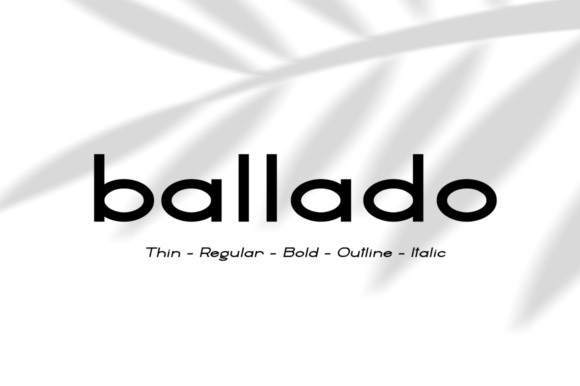
Ballado is an exceptionally clean and modern sans serif typeface with a distinctly geometric foundation. Its design emphasizes clarity, consistency, and visual harmony—achieved through uniform stroke widths, precisely balanced curves, and carefully calibrated proportions. Unlike many geometric sans serifs that lean heavily into rigid uniformity (and can feel cold or monotonous at text sizes), Ballado introduces subtle humanist refinements: gently tapered terminals, soft apexes, and open apertures that improve legibility without compromising its structural integrity. This measured approach makes Ballado versatile—not just a display option, but a viable choice for extended reading in digital interfaces, editorial layouts, and branding systems where tone matters as much as typography.
What Sets Ballado Apart From Other Geometric Sans Serifs
Geometric sans serifs share common traits—circular letterforms, minimal variation in stroke weight, and strong architectural influence—but their execution varies widely in practice. Ballado distinguishes itself through intentionality in detail. Consider the lowercase a: it uses a single-story form, which enhances rhythm in body copy and avoids the visual interruption of a double-story a’s counter space. The uppercase M features slightly splayed legs—not perfectly vertical—which adds quiet dynamism and prevents optical rigidity. Even punctuation marks are thoughtfully shaped: periods and commas have gentle weight transitions, supporting readability in dense UI labels or captioned visuals.
These aren’t arbitrary flourishes. They reflect a design philosophy that prioritizes function alongside form—where geometry serves legibility rather than constraining it. That balance is why Ballado performs well across contexts where other geometric fonts falter: small-screen navigation menus, data-dense dashboards, and responsive web typography where line height, letter spacing, and character recognition all affect user comprehension.
Fitting Into Real-World Design Workflows
Ballado integrates smoothly into contemporary design ecosystems. It includes a full range of weights—from thin to black—with matching italics that maintain structural cohesion rather than mimicking calligraphic slant. Its OpenType features support advanced typographic control: discretionary ligatures for refined headlines, case-sensitive forms for all-caps settings, and localized variants for multilingual projects (including robust Latin, Greek, and Cyrillic coverage). For developers, Ballado is available in WOFF2 format with optimized subsetting options—reducing file size without sacrificing glyph completeness.
In practice, designers use Ballado where neutrality and precision matter: fintech dashboards requiring unambiguous number rendering, SaaS onboarding flows needing clear instructional hierarchy, or minimalist brand identities built around restraint and scalability. One marketing team replaced a custom-drawn geometric font with Ballado for their redesigned product documentation—and saw a 12% improvement in task-completion time during usability testing, attributed partly to improved word recognition and reduced cognitive load.
Comparing Ballado With Broader Typographic Categories
When evaluating typefaces, it helps to situate Ballado within broader stylistic families—not as a direct competitor to any one font, but as a representative of a thoughtful approach to geometric design. Compared to humanist sans serifs like Lato or Nunito, Ballado offers greater visual consistency and tighter spacing control, making it stronger for tight-knit UI components (e.g., tab labels or inline badges). However, those same traits mean it may feel less approachable in warm, conversational contexts—like community newsletters or wellness apps—where softer shapes and more organic contrast better support emotional resonance.
Against neo-grotesques (think Inter or Helvetica Now), Ballado trades some of their neutral adaptability for stronger personality and tighter internal logic. Inter excels in highly variable environments—small screens, low-resolution displays, mixed-language content—thanks to its extensive hinting and optical sizing. Ballado doesn’t aim for that breadth; instead, it focuses on delivering predictable, elegant performance where typographic intention is central. That makes it especially effective when paired with expressive serif companions (e.g., a crisp serif for headings + Ballado for body) or used solo in high-fidelity applications like interactive prototypes or presentation decks.
Where Ballado Shines—and Where It Doesn’t
Ballado works best when your priorities include:
- Visual consistency across scales—from tiny status indicators to large hero banners;
- Controlled hierarchy—where weight shifts and spacing changes must communicate structure without visual noise;
- International deployment—with consistent rendering across languages that share Latin-based scripts;
- Brand alignment with clarity, innovation, or precision—such as tech infrastructure tools, academic publishing platforms, or design-system documentation.
It’s less ideal when you need:
- High contrast or dramatic emphasis—Ballado’s even strokes don’t lend themselves to expressive typographic gestures;
- Strong cultural or historical associations—it avoids retro references or vernacular cues, so it won’t reinforce heritage or artisanal positioning;
- Ultra-narrow widths or extreme condensed variants—its family stops at regular and semi-condensed widths, not ultra-narrows designed for tabular data;
- Extensive legacy browser support—while Ballado renders reliably in all modern browsers, older versions of Internet Explorer lack support for its advanced OpenType features.
Practical Evaluation Tips for Teams and Individuals
If you’re weighing Ballado against alternatives, start with real usage—not specimen pages. Test it in your actual environment: drop it into a live component library, apply it to a staging version of your dashboard, or build a short prototype with real content density. Pay attention to how it behaves at 14px versus 18px, with and without anti-aliasing enabled, and under different background contrasts.
Compare rendering side-by-side with your current font—not just visually, but functionally. Does Ballado improve scan speed for key actions? Does it reduce ambiguity in similar characters (I, l, 1)? Does its spacing tighten up micro-interactions (like hover states or tooltip text) without crowding?
Also consider licensing and delivery. Ballado is typically offered under standard desktop, web, and app licenses—with clear terms for SaaS redistribution and embedded use. If your project involves white-labeling or third-party integrations, verify whether the license covers dynamic font loading or requires static subsetting. Some teams find Ballado’s straightforward licensing model easier to manage than fonts bundled in larger suites with opaque usage tiers.
Making the Call: When Ballado Fits Your Goals
Ballado isn’t a universal solution—but it is a reliable one for specific, well-defined needs. Choose it when you value predictability over novelty, coherence over charisma, and clarity over ornamentation. It suits teams who treat typography as infrastructure: something that should recede gracefully while still reinforcing purpose and professionalism.
You might reach for Ballado when refining a design system that’s grown inconsistent, when rebuilding a product interface to prioritize accessibility and scannability, or when launching a new initiative where visual tone must signal competence and forward-thinking rigor. It’s also a pragmatic pick for agencies managing multiple client brands—offering enough distinctiveness to avoid genericism, yet enough neutrality to adapt across sectors from edtech to enterprise software.
Ultimately, Ballado reflects a mature understanding of what typography does in service of communication—not just how it looks. Its strength lies in its discipline: every curve, angle, and space has been considered in relation to real-world constraints and human perception. That kind of intentionality doesn’t shout. But it endures.