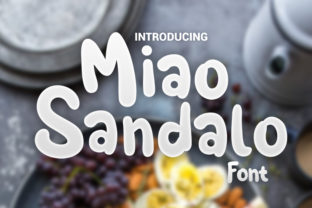
Miao Sandalo: A Handmade Font That Supports Intentional Design Decisions
Miao Sandalo is a beautiful handmade font—crafted with visible stroke variation, organic rhythm, and quiet confidence. It’s not designed for speed or scalability alone. Instead, it invites pause. It rewards attention. And when used with clarity of purpose, it becomes more than typography—it becomes part of your strategic communication infrastructure.
Why Miao Sandalo Fits Real-World Design Strategy
Most fonts are chosen for legibility, compatibility, or trend alignment. Miao Sandalo serves a different function: it supports intentionality. Its hand-drawn warmth signals care—not just in aesthetics, but in how you position ideas, frame messages, and shape perception. For entrepreneurs launching a values-driven brand, educators designing learning materials, or freelancers building a distinctive visual voice, Miao Sandalo works best when it reflects a deliberate choice—not an aesthetic afterthought.
This isn’t about “adding charm.” It’s about reinforcing coherence. When your brand voice is thoughtful, grounded, and human-centered, Miao Sandalo can amplify that alignment. When your content prioritizes reflection over reaction—like a newsletter on mindful productivity, a workshop guide on creative leadership, or packaging for small-batch ceramics—its texture feels earned, not decorative.
Where Miao Sandalo Delivers Measurable Value
Strategic use of Miao Sandalo shows up most clearly in contexts where emotional resonance and memorability matter more than raw efficiency:
- Brand identity systems—especially for service-based businesses, artisan studios, or wellness practices where authenticity is a differentiator;
- Editorial design—book covers, zines, or long-form digital publications where tone and pacing influence reader engagement;
- Print collateral—invitations, letterpress stationery, or exhibition signage where physical presence reinforces message weight;
- Educational resources—handouts, course workbooks, or facilitation tools where visual warmth lowers cognitive barriers to learning;
- Customer touchpoints—thank-you notes, onboarding emails, or limited-edition product labels that deepen relational equity.
In each case, Miao Sandalo isn’t carrying the full weight of meaning—but it’s quietly supporting it. It helps audiences register: This was made by someone who considered how this would feel to receive.
When to Use Miao Sandalo—and When to Pause
Miao Sandalo excels at emphasis, not exposition. It’s rarely ideal for body text in web interfaces, dense reports, or multi-language applications where consistency and accessibility thresholds must be rigorously met. Before selecting it, ask yourself:
- What outcome am I trying to support? If the goal is clarity at scale (e.g., dashboard labels, legal disclaimers), a neutral, highly legible typeface will serve better.
- Is this the right layer for emotional signaling? Fonts communicate before words do—but only if they’re placed where users have time and context to absorb them. A headline in Miao Sandalo on a landing page works. A navigation menu in Miao Sandalo likely doesn’t.
- Do I have control over rendering conditions? Handmade fonts like Miao Sandalo rely on precise hinting and modern font loading behavior. Test across devices, browsers, and connection speeds—especially if deploying on platforms with limited CSS control (e.g., some email clients or CMS templates).
Using Miao Sandalo without answering these questions risks misalignment—not because the font is flawed, but because its strengths lie in specificity, not universality.
How to Integrate Miao Sandalo Without Compromising Practicality
Start with hierarchy, not decoration. Define one or two clear roles for Miao Sandalo in your system—then hold those boundaries. Common, effective pairings include:
- Headlines + neutral sans-serif body text (e.g., Miao Sandalo for section titles paired with Inter or Lato for paragraphs);
- Accent quotes + serif body copy (e.g., pull quotes in Miao Sandalo alongside Adobe Garamond or PT Serif);
- Logo lockups + system font fallbacks (e.g., using Miao Sandalo only in static logo assets, while interface text relies on robust web fonts).
Avoid layering multiple expressive fonts. Miao Sandalo’s character comes from restraint—not accumulation. One well-placed instance often communicates more than three scattered ones.
Also consider technical execution. Self-host the font file rather than relying solely on third-party CDNs if performance and branding control matter. Subset characters if you’re using it narrowly (e.g., Latin-only for English projects) to reduce payload. And always define fallback stacks—font-family: "Miao Sandalo", "Avenir Next", -apple-system, sans-serif;—so layout integrity remains intact even if the primary font fails to load.
Risks of Using Miao Sandalo Without Context
The biggest risk isn’t technical—it’s perceptual. When applied without grounding in strategy, Miao Sandalo can unintentionally signal inconsistency, informality, or lack of polish—especially in sectors where precision and authority are expected (e.g., financial services, B2B SaaS, academic publishing). That’s not a flaw in the font; it’s a mismatch between tool and context.
Another subtle risk is dilution. Using Miao Sandalo everywhere—on social posts, invoices, slide decks, error messages—flattens its impact. Its power lies in contrast. Overuse erodes distinction and weakens the very emotional resonance it’s meant to convey.
Finally, consider audience expectations. A tech startup targeting enterprise buyers may find Miao Sandalo creates friction in early credibility-building. But that same startup, launching a community-led sustainability initiative, might use it precisely to signal departure from conventional corporate tone. Context shapes interpretation.
Long-Term Thinking: How Miao Sandalo Supports Sustainable Branding
Brands built on trends age quickly. Brands built on coherence endure. Miao Sandalo supports longevity not by being “timeless” in the abstract, but by encouraging decisions rooted in real constraints and real goals: Who are you speaking to? What do they need to feel before they act? What impression must remain after the screen goes dark—or the brochure is set aside?
That kind of thinking slows down the design process—in a good way. It asks you to articulate why a particular warmth, irregularity, or softness matters to this project, right now. That discipline transfers beyond typography. It strengthens messaging, sharpens positioning, and improves cross-functional alignment—because everyone involved understands the rationale, not just the result.
Over time, consistent, thoughtful application of Miao Sandalo—even in small doses—builds recognition through repetition of feeling, not just form. People may not name the font, but they’ll recall the sense of groundedness it contributed to your website’s “About” page, or the sincerity in your annual impact report’s opening letter.
Practical Next Steps for Intentional Use
If you’re considering Miao Sandalo for an upcoming project, try this sequence:
- Map one key user journey—e.g., how someone moves from seeing your Instagram ad → clicking to your site → reading your core offer → deciding to sign up. At which touchpoint would Miao Sandalo add meaningful emotional reinforcement? Where would it distract?
- Sketch two versions of that moment—one with Miao Sandalo applied intentionally (e.g., only the headline and CTA button label), one with a neutral alternative. Share both with a trusted colleague who represents your target audience. Ask: “Which feels more aligned with what you’d expect from this kind of offering?”
- Document your rationale—not just “I like it,” but “This supports our goal of conveying approachable expertise in a crowded market, and contrasts effectively with the clean UI we use elsewhere.” Store that note with your brand guidelines.
Miao Sandalo doesn’t replace strategy—it reveals it. The more clearly you understand your objectives, the more effectively this handmade font can serve them. And the more consistently you apply it with purpose, the more it contributes to outcomes that last longer than a seasonal redesign.