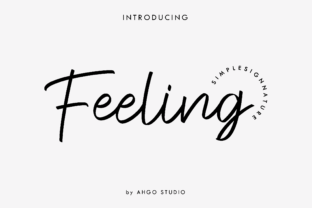
Feeling Signature: A Strategic Choice for Modern Brand Expression
Feeling Signature isn’t just another handwritten font—it’s a deliberate design decision with tangible impact on how your audience perceives authenticity, approachability, and intention. Designed with clean lines, balanced spacing, and subtle organic variation, it bridges the warmth of human touch with the clarity of modern typography. That balance matters—not as an aesthetic footnote, but as a functional asset in how you position yourself, communicate value, and build recognition across touchpoints.
Why Feeling Signature Fits Real-World Business Needs
When you choose a typeface, you’re not selecting decoration—you’re selecting a voice. Feeling Signature speaks with quiet confidence: personal without being casual, expressive without sacrificing legibility, distinctive without demanding attention at the expense of message. That makes it especially effective where trust and clarity intersect—like business cards handed to potential clients, logos anchoring a service-based website, or magazine covers signaling thoughtful curation.
Unlike highly stylized scripts that limit scalability or readability, Feeling Signature maintains integrity at small sizes (e.g., 8–10 pt on a printed flyer) and holds up well in digital contexts—from email headers to social media banners. Its lowercase-dominant rhythm encourages scanning, while its consistent baseline and open letterforms support quick comprehension—critical when your audience is deciding in seconds whether to engage further.
Strategic Use Cases—and When to Pause
Feeling Signature shines most when your goal is to reinforce human-centered positioning: a therapist’s practice emphasizing empathy, a boutique studio highlighting craftsmanship, an educator building connection through course materials, or a sustainable brand communicating care over convenience. In those cases, it supports—not distracts from—the substance of your offer.
But it’s not universally optimal. Avoid using Feeling Signature for legal disclaimers, technical documentation, data-heavy reports, or interfaces requiring rapid scanning of dense information. Its strength lies in evoking tone—not delivering precision. If your primary objective is neutrality, authority, or speed of parsing (e.g., dashboards, regulatory signage, multilingual interfaces), a more structured sans-serif may serve better.
Also consider context before committing. A tech startup launching an AI-powered analytics platform might unintentionally undermine perceived rigor by leading with Feeling Signature in its core logo—even if used thoughtfully elsewhere (e.g., blog headers or newsletter sign-ups). The question isn’t “Is it beautiful?” but “Does it align with what this audience needs to believe about us *right now*?”
Practical Integration Guidelines
- Pair intentionally: Combine Feeling Signature with a neutral, highly legible sans-serif (e.g., Inter, Lato, or even Helvetica Neue) for body text, captions, or supporting copy. This contrast creates visual hierarchy while preserving readability and professionalism.
- Limit scope: Use it for primary headlines, logos, callouts, or short quotes—not full paragraphs. Overuse dilutes impact and strains reading flow.
- Test across mediums: Print it at actual size on your intended paper stock. View it on mobile screens at typical viewing distance. Check contrast ratios against background colors—especially important for accessibility compliance.
- Consider licensing early: Feeling Signature is available under commercial licenses, but usage rights vary by vendor. Confirm permissions for web embedding, app integration, or merchandise before finalizing designs.
How Feeling Signature Supports Long-Term Brand Clarity
Consistency builds recognition—but consistency rooted in strategy builds resonance. When Feeling Signature appears across your business card, email signature, presentation deck title slide, and Instagram bio, it becomes part of a coherent sensory cue. That repetition doesn’t just make you more memorable; it quietly reinforces a specific impression: that you value intentionality, human connection, and refined simplicity.
This isn’t about chasing trends. It’s about choosing tools that scale with your growth—not just visually, but conceptually. A freelancer transitioning from solo projects to a small team can retain Feeling Signature in their logo while adopting more structured typography for internal documentation. The font becomes a stable anchor, even as systems mature.
For educators and creators, Feeling Signature also supports learning retention. Studies suggest that moderately variable, human-like letterforms can increase engagement with short-form written material—particularly when paired with clear structure and purposeful whitespace. That makes it useful for workshop handouts, course module titles, or visual summaries meant to be glanced at and remembered.
Risks of Using Feeling Signature Without Strategy
The biggest risk isn’t poor execution—it’s misalignment. Using Feeling Signature because it’s “trendy” or “pretty” without considering audience expectations, industry norms, or strategic goals often leads to inconsistent messaging. You may attract attention, but not the right kind—or worse, confuse your positioning entirely.
Another common oversight: assuming handwriting implies informality. While Feeling Signature avoids exaggerated flourishes, its organic nature still signals subjectivity. That works powerfully for a life coach inviting reflection—but could undercut credibility for a financial advisor presenting retirement projections. The mismatch isn’t about quality; it’s about cognitive framing.
There’s also a practical risk in over-customization. Some users apply heavy tracking adjustments, extreme scaling, or color overlays to “make it pop,” inadvertently compromising legibility or emotional tone. Feeling Signature’s strength lies in its restraint—so resist the urge to overwork it.
Making Intentional Decisions—Not Just Aesthetic Ones
Before applying Feeling Signature to any project, ask three questions:
- What outcome do I want this piece to drive? (e.g., “Encourage sign-ups for a free workshop,” “Signal premium service quality,” “Differentiate from corporate competitors.”)
- What does my audience need to feel or understand *before* they act? (e.g., “That I listen,” “That this is trustworthy,” “That creativity is welcome here.”)
- Where will this appear—and what else will surround it? (e.g., “On a matte-finish business card next to a minimalist icon,” “As a hero headline above a product photo on mobile,” “In a PDF report shared with stakeholders.”)
If Feeling Signature clearly supports answers to all three, proceed. If it only satisfies one—or introduces ambiguity—pause and explore alternatives. Typography is never neutral. Every choice carries weight, especially in saturated markets where differentiation hinges on subtlety, not spectacle.
Planning Ahead for Scalable Use
Think beyond the immediate deliverable. If you’re designing a brand system, define clear rules for Feeling Signature usage: maximum point size for print, minimum contrast ratio for web, approved pairings, and prohibited modifications (e.g., no vertical stretching, no automatic all-caps conversion). Document these—not as constraints, but as commitments to coherence.
For freelancers and small teams, consider creating lightweight templates: a Canva business card layout, a Notion cover page preset, or a Figma text style library. These reduce decision fatigue and ensure Feeling Signature remains a strategic tool—not a variable to renegotiate every time.
And remember: fonts don’t build brands—people do. Feeling Signature supports your voice, but it doesn’t replace clarity of message, consistency of action, or authenticity of interaction. Use it as one calibrated element within a broader system of communication—one that serves your goals, respects your audience, and evolves with intention.