Donut: A Playful, Versatile Font Inspired by Doughnuts
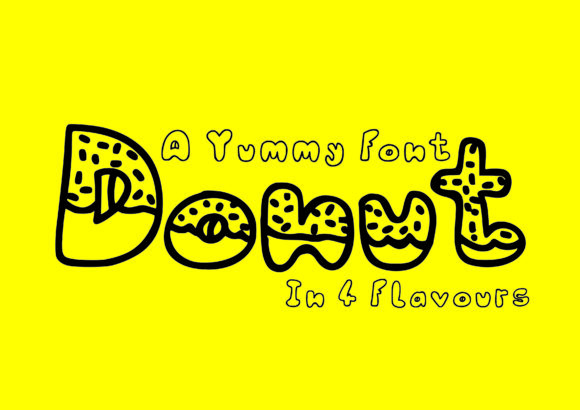
Donut isn’t just another decorative typeface—it’s a carefully crafted font family shaped like your favourite sweet treat. Rounded, friendly, and full of character, Donut invites warmth and approachability without sacrificing clarity or usability. With four distinct weights—Sprinkles, Icing, Plain, and Full Hog—you’re not just picking a font; you’re choosing a tone, a mood, and a visual rhythm that fits your message.
What Makes Donut Different?
Unlike many display fonts that sacrifice legibility for flair, Donut balances charm with function. Each weight has been designed with consistent proportions, open counters, and generous spacing—so it works as well on a mobile screen as it does on a café chalkboard or a product label. The “Sprinkles” weight adds subtle texture and whimsy, ideal for playful headlines. “Icing” smooths things out with gentle curves and soft edges—perfect for invitations or brand storytelling. “Plain” strips back the extras for clean, confident readability in body text or UI labels. And “Full Hog”? That’s the bold, layered version where all elements come together—great for hero banners, packaging, or social media graphics that need to stop the scroll.
Why Designers and Marketers Reach for Donut
For designers and marketers, type is one of the fastest ways to signal brand personality. A tech startup launching a fun, accessible app might use “Sprinkles” for its CTA buttons to evoke joy and lightness. A local bakery could pair “Icing” for menu headers with “Plain” for ingredient lists—creating visual hierarchy while staying true to its handmade, welcoming vibe. Because Donut’s weights share the same underlying structure, switching between them feels intuitive—not jarring. That consistency saves time in design systems and helps maintain coherence across websites, print materials, and ads.
Beginners Find It Friendly (and Forgiving)
If you’re new to typography—or even just starting with Canva, Figma, or Google Docs—you’ll appreciate how Donut removes guesswork. There’s no steep learning curve. You don’t need to adjust tracking, kerning, or baseline shifts to make it look right. Pick a weight, type a sentence, and it just works. That immediacy matters when you’re building your first portfolio site, designing an Instagram post for your side hustle, or drafting a newsletter for your community group. Donut gives beginners room to experiment without fear of “getting it wrong.”
For Educators and Content Creators, Clarity Is Key
Educators crafting handouts, slide decks, or digital worksheets often juggle accessibility, engagement, and simplicity. Donut’s open letterforms and generous x-height support readability for younger learners and neurodiverse audiences alike. Try “Plain” for instructions or definitions—it’s clear at small sizes and holds up well in PDFs or printed copies. Meanwhile, “Icing” can highlight key concepts or section titles without overwhelming students. One teacher used “Sprinkles” for classroom reward certificates—and reported that kids instantly recognised the playful energy, making learning feel more personal and joyful.
Small Business Owners Value Its Flexibility
When you run a small business, every tool needs to pull double duty. Donut does exactly that. A florist uses “Icing” for her website’s “About” page headline and “Plain” for service descriptions—keeping things warm but professional. A freelance illustrator pairs “Full Hog” with minimalist sans-serif body text to create striking portfolio thumbnails. Even better? Donut’s licensing is straightforward and includes web, desktop, and app use—no hidden fees or complicated tiers. That predictability helps owners plan budgets without surprises.
Hobbyists and Makers Love Its Expressive Range
Whether you’re designing custom stickers, embroidering quotes onto tote bags, or printing recipe cards for friends, Donut adapts. Its rounded terminals and soft joins give hand-drawn charm without needing illustration skills. Try “Sprinkles” overlaid on pastel backgrounds for craft fair signage—or “Full Hog” carved into wood grain for rustic wedding stationery. Because the weights are designed to complement each other, mixing them feels natural, not forced. One hobbyist shared how she used all four weights across a single holiday card set—each variation matched a different recipient’s personality, from her playful niece (“Sprinkles”) to her no-nonsense dad (“Plain”).
What About Quality and Long-Term Use?
Donut was built with real-world use in mind—not just aesthetics. It includes full Latin character sets, standard punctuation, numerals, and common diacritics. It renders crisply at any size, from tiny favicon text to billboard-scale headlines. No pixelation. No inconsistent spacing. That reliability means you can use it today for a one-off project—and still feel confident pulling it out five years later for your next rebrand or course launch.
How to Know If Donut Fits Your Needs
Ask yourself:
- Do you value ease over complexity? If setting up a font feels like solving a puzzle, Donut’s plug-and-play nature may be a relief.
- Is tone as important as information? If your work lives at the intersection of emotion and utility—like wellness coaching, parenting blogs, or creative workshops—Donut helps convey warmth without sounding childish.
- Do you need variety without fragmentation? If you’ve ever struggled to find two fonts that “go together,” Donut’s unified family solves that in one download.
- Are you balancing creativity with practicality? If your projects range from quick social posts to client deliverables, having four usable weights in one package reduces decision fatigue and keeps your workflow steady.
It’s not for every context—Donut wouldn’t be the first choice for legal contracts, academic journals, or high-density data dashboards. But where personality, accessibility, and visual cohesion matter, it earns its place.
Ultimately, Donut meets people where they are: whether you're sketching ideas on napkins, building a Shopify store before dawn, or helping students connect with new vocabulary. It doesn’t ask you to change your process—it fits into it. And sometimes, the best tools aren’t the flashiest ones. They’re the ones that feel like they were made just for what you’re trying to do right now.