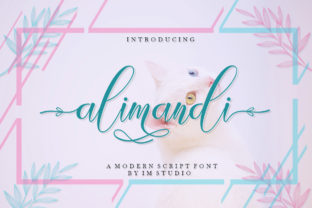
Alimandi: A Light & Charming Handwritten Font
If you’ve ever held a hand-lettered greeting card, flipped through a boutique stationery catalog, or admired the quiet confidence of a small-batch jam label, you know the warmth that comes from human touch. Alimandi captures that feeling—not as an imitation, but as a considered, graceful reinterpretation of handwriting. It’s not fussy or overly ornate; it’s light, airy, and gently expressive—like ink drawn with a fine nib on textured paper. The lowercase letters have soft entry and exit strokes, subtle variation in stroke weight, and just enough irregularity to feel personal without sacrificing clarity.
Where Alimandi Fits Naturally—and Where It Doesn’t
Alimandi is a display font, not a workhorse text face. That means it shines brightest where attention, mood, and intention matter most: logo design for artisanal brands, editorial headlines in indie magazines, packaging for handmade soaps or ceramic studios, social media graphics for craft-based businesses, and invitations for intimate weddings or creative workshops. Its personality aligns effortlessly with values like authenticity, care, and quiet confidence.
It’s less suited for body copy, dense legal disclaimers, or interfaces requiring rapid scanning—think app navigation menus or data dashboards. You wouldn’t use Alimandi for a pharmaceutical brochure’s dosage instructions, nor for a tech startup’s feature comparison table. That’s not a limitation—it’s clarity of purpose. Like choosing linen over polyester for a summer dress, Alimandi works because it’s intentionally selective.
How It Shapes Perception—Without Saying a Word
Typefaces don’t communicate in sentences—but they do set tone, pace, and expectation. When you use Alimandi, you’re signaling that your brand values craftsmanship over speed, nuance over noise. In publishing, it adds tactile intimacy to a poetry chapbook cover. In packaging design, it helps a small-batch candle brand feel distinct from mass-market competitors—even before the scent is detected. For bloggers and content creators, it gives headers a gentle, human rhythm that invites reading rather than skimming.
Consistency matters: using Alimandi across a website’s hero headline, Instagram story banners, and printed business cards reinforces recognition. But consistency isn’t repetition—it’s thoughtful application. A single line of Alimandi in a clean sans serif layout (like Inter or Poppins) creates visual hierarchy without clutter. Overuse—say, stacking three lines of it in varying sizes on a landing page—can dilute its charm and reduce legibility at smaller sizes.
Practical Pairing: What Works Well With Alimandi
Because Alimandi is a handwritten font, contrast is key. It pairs best with typefaces that ground it: neutral, well-proportioned sans serifs (e.g., Lato, Montserrat, or the slightly warmer Work Sans), or even a restrained serif like Merriweather or PT Serif for editorial projects. Avoid pairing it with other script or display fonts—two personalities competing for attention rarely coexist gracefully.
In practice: try Alimandi for a product name on a food label, set in 24–36pt, with ingredient lists in a clean 9–10pt sans serif. Or use it for a blog post title at 48pt, then drop into 18pt Roboto for the byline and 16pt for body text. Test print samples—what reads beautifully on screen may tighten or blur on uncoated stock. And always check line spacing: Alimandi benefits from generous leading (1.4–1.6x) to preserve its airiness.
Licensing, Formats, and Real-World Fit
Alimandi is a commercial font, meaning it requires a license for business use—including client work, merchandise, digital ads, and published books. Most reputable vendors offer clear licensing tiers: desktop-only, webfont, app embedding, or extended licenses for large-scale distribution. If you’re a designer delivering assets to a client, confirm whether their license covers redistribution—or whether they need to purchase their own.
The font typically includes one weight (regular) with standard Latin characters, basic punctuation, and often OpenType features like ligatures and alternate glyphs. It doesn’t include bold or italic variants—so if your project needs typographic emphasis, rely on size, color, or spacing instead of weight shifts. That constraint, honestly, encourages smarter design decisions.
Before committing, download a trial (if available) and test it in context: paste real headlines into your CMS, mock up a Shopify product card, or lay it over a photo background in Figma. Does it hold up at 20px on mobile? Does it feel balanced next to your brand’s primary color? Does it complement—not compete with—the imagery or photography? These aren’t theoretical questions. They’re the difference between a font that serves your message and one that distracts from it.
A Few Quiet Observations From Real Projects
A ceramics studio used Alimandi for their “Made in Portland” stamp on shipping boxes—small, centered, and slightly off-kilter. Customers photographed and shared it organically. Why? Because it felt intentional, not automated.
An independent publisher chose Alimandi for chapter titles in a memoir about learning pottery. Readers told them the typography made the text feel like a quiet conversation—not a lecture. That wasn’t accidental. The font’s modest x-height and open counters created breathing room around emotionally dense passages.
A wedding planner avoided trendy brush scripts and went with Alimandi for save-the-dates. Clients responded that it felt “thoughtful, not flashy”—a subtle reflection of her calm, detail-oriented process.
None of these uses required technical mastery. They required observation, restraint, and respect for what Alimandi does well—and what it leaves space for.
So if you’re weighing fonts for a new project, ask yourself: does this need energy—or ease? Boldness—or breath? Alimandi won’t shout. But when the right words meet the right rhythm, it listens closely—and lets them be heard.