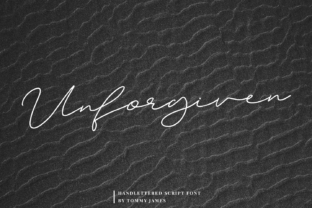
Unforgiven: A Sweet Script Font That Stands Out
When you’re choosing a font for a wedding invitation, a boutique logo, or a heartfelt social media post, tone matters as much as content. Unforgiven isn’t just another script font—it’s a carefully balanced blend of warmth, legibility, and quiet confidence. Its soft curves, gentle contrast, and natural rhythm give it the feel of hand-drawn elegance without sacrificing clarity at small sizes or on screen. For creators who need personality *and* professionalism in one typeface, Unforgiven delivers with understated precision.
Why Simplicity Works—Especially When It’s Thoughtful
“Sweet and simple” sounds easy—but simplicity in typography is rarely accidental. Unforgiven’s design avoids excessive flourishes, tight letter spacing, or exaggerated swashes that can distract or reduce readability. Instead, it offers subtle entry and exit strokes, consistent x-height, and open counters that keep letters distinct even in body text or captions. That means you spend less time adjusting tracking or kerning manually—and more time focusing on your message.
Take a small-batch candle brand launching its first Instagram campaign. The owner wants to evoke care, authenticity, and handmade charm—not corporate polish. Using Unforgiven for product labels and story text creates immediate visual cohesion: warm, inviting, and human-scaled. It doesn’t shout; it invites closer attention. And because it pairs well with clean sans-serifs like Inter or Lato, it supports hierarchy without competing.
Where Unforgiven Fits Best—And Where It Might Not
Unforgiven shines in contexts where emotional resonance matters more than rigid formality. It’s especially effective for:
- Personal branding—freelancers, coaches, or artists whose voice is central to their offering;
- Printed keepsakes—wedding stationery, baby announcements, thank-you notes;
- Digital storytelling—blog headers, newsletter banners, or ebook chapter titles;
- Small business identity—local bakeries, florists, wellness studios seeking approachable distinction.
It’s less ideal for dense UI interfaces, legal disclaimers, or technical documentation—situations where neutrality, speed of scanning, and universal legibility take priority. Unforgiven isn’t meant to replace Helvetica or Roboto in functional settings. Rather, it fills a specific expressive gap: when you want your typography to echo sincerity, not sterility.
Real-Time Workflow Benefits You’ll Notice Fast
Designers often underestimate how much time gets lost wrestling with fonts that look great in mockups but break down in production. Unforgiven includes standard OpenType features (ligatures, contextual alternates) that activate automatically in most modern design tools—including Figma, Adobe Creative Cloud, and Canva Pro. That means smoother transitions from concept to export, fewer manual fixes, and consistent rendering across platforms.
For educators designing printable classroom resources, this reliability matters. A teacher creating a “Kindness Challenge” poster can use Unforgiven for the title and subhead, then switch cleanly to a readable sans-serif for instructions—knowing the script won’t pixelate on student tablets or print faintly on budget printers. No extra plugins. No font substitution surprises.
Pairing Unforgiven Without Overcomplicating
Good pairing isn’t about contrast for contrast’s sake—it’s about supporting function while preserving feeling. With Unforgiven, aim for balance, not opposition. A light or regular weight of a neutral sans-serif (like Poppins, Montserrat, or even system fonts like SF Pro Display) provides clear structure underneath its lyrical flow. Avoid overly decorative companions—two expressive fonts often cancel each other out.
One practical tip: test hierarchy by writing your actual content—not placeholder text. Try “Welcome to Our Studio” in Unforgiven, followed by “We offer custom lettering, workshops, and branding support” in your secondary font. Does the shift feel intentional? Does the meaning land before the style distracts? If yes, you’ve struck the right balance.
Who Gains the Most—and Why It’s Worth Trying
Freelancers building client-facing portfolios benefit immediately. A single strong font choice like Unforgiven signals intentionality—even before someone reads a single case study. Bloggers and content creators see lift in engagement when headlines feel personal rather than algorithmic. Small business owners without in-house designers appreciate how little adjustment Unforgiven needs to look polished across Canva templates, Shopify banners, and email headers.
But perhaps the quietest advantage is psychological: using Unforgiven gently reinforces a creative mindset rooted in authenticity. It reminds you—not through rules, but through rhythm—that communication works best when it feels human first. That’s not marketing speak. It’s what happens when you choose a typeface that doesn’t ask viewers to work harder to connect.
A Note on Licensing and Practical Use
Unforgiven is available under standard desktop and web licensing terms—meaning you can use it in client projects, printed materials, and hosted websites without additional fees (always verify current terms from the foundry). It supports Latin-based languages and basic diacritics, making it suitable for U.S., Canadian, UK, Australian, and many European markets. If your project requires extended language support (e.g., Vietnamese, Turkish, or Central/Eastern European characters), check the character set before committing.
Also worth noting: while Unforgiven renders beautifully on high-DPI screens, avoid using it below 16px in body copy on websites. Its delicate stroke contrast softens at very small sizes. For accessibility compliance, reserve it for headings, quotes, or short accent text—and always pair with a WCAG-compliant fallback for paragraph content.
Final Thought: Stand Out by Being True—Not Just Bold
In a landscape saturated with aggressive gradients, bold serifs, and ultra-thin fonts designed for virality, Unforgiven offers something rarer: quiet distinction. It doesn’t demand attention—it earns it. Whether you’re naming a new podcast, designing a nonprofit’s annual report, or handwriting a note to a valued client, Unforgiven helps your words carry weight *because* they feel genuine.
You don’t need dramatic shifts to improve your design outcomes. Sometimes, it’s as simple as choosing a script font that respects both the reader’s eye and the writer’s intent. Unforgiven does that—not loudly, but consistently. And in creative work, consistency built on intention is where real standout moments begin.