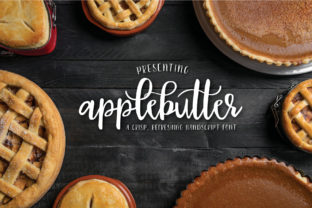
Applebutter: A Whimsical Hand-Lettered Font
If you’ve ever held a hand-calligraphed wedding invitation, admired the warmth of a small-batch jam label, or paused to savor the charm of a vintage-style art print—you know the quiet power of authenticity in typography. Applebutter isn’t just another script font. It’s a carefully crafted, hand-lettered typeface that carries the gentle irregularity of ink on paper, the subtle variation of pressure and rhythm, and the unmistakable warmth of human touch.
Designed for creators who value intention over automation, Applebutter bridges the gap between digital convenience and tactile sincerity. It doesn’t try to mimic perfection—it embraces the slight wobble in a curve, the soft taper of a stroke, the organic spacing that feels *lived-in*. That’s why it stands out in a landscape crowded with overly polished, algorithmically smoothed scripts.
What Makes Applebutter Distinctive
At its core, Applebutter is a single-weight, connected script—yet it avoids the rigidity many scripts fall into. Its letterforms breathe: ascenders rise with gentle confidence, descenders loop with quiet playfulness, and ligatures (like “fi”, “fl”, and “st”) flow without forcing uniformity. There are no alternate characters or stylistic sets—by design. Instead, its strength lies in consistency of voice, not variety of options.
It’s highly legible at medium to large sizes—ideal for headlines, quotes, and focal text—but intentionally less suited for dense body copy. That’s not a limitation; it’s a thoughtful boundary. Applebutter excels where attention matters most: where you want eyes to linger, not skim.
Its whimsy isn’t childish—it’s mature and grounded. Think heirloom recipe cards, not cartoon balloons. The lowercase “a” has a soft, open bowl; the “g” features a modest, curling tail; the “s” begins with a confident entry stroke and ends with a graceful exit. These details aren’t arbitrary—they’re the result of deliberate, iterative hand-drawing and digital refinement.
Where Applebutter Fits Naturally
You don’t need a graphic design degree to use Applebutter well—you just need clarity about *why* you’re choosing it. Here’s where it consistently delivers:
- Invitations & Stationery: Wedding suites, baby announcements, holiday cards—any moment where personal significance meets visual warmth. Pair Applebutter for names and dates with a clean, neutral sans-serif (like Inter or Lato) for addresses and details. The contrast elevates both.
- Art Prints & Wall Decor: Short poetic lines, botanical labels, or family mottos gain emotional resonance when set in Applebutter. Its texture holds up beautifully in print—even on textured cotton rag paper—without losing character.
- Branding for Small Businesses: Artisan bakeries, indie bookshops, ceramic studios, and local apothecaries often seek fonts that reflect care, craft, and continuity. Applebutter works subtly in logos (especially wordmarks), packaging accents, and social media banners—never shouting, always inviting.
- Educational Materials: Teachers and curriculum designers use Applebutter for classroom posters, reading corner signage, or student award certificates. Its approachability helps soften formal learning environments without sacrificing professionalism.
- Digital Use (With Intention): On websites, it shines in hero sections, testimonial highlights, or email headers—always as webfont via Google Fonts or self-hosted WOFF2. Avoid using it for navigation menus or long paragraphs. Let it punctuate—not dominate.
Real-World Considerations Before You Use It
Like any tool, Applebutter performs best when matched to realistic expectations. Here’s what seasoned users observe:
First, licensing matters. Applebutter is free for personal use, but commercial projects—including client work, product packaging, or paid digital templates—require a license. Always verify the source (official foundry or authorized distributor) and read the EULA. Using unlicensed fonts risks legal exposure and undermines the designer’s labor.
Second, pairing is essential. Applebutter thrives alongside typefaces with clear contrast in weight, structure, and tone. Avoid other scripts or decorative fonts nearby—they compete instead of complement. A crisp geometric sans-serif or a warm, low-contrast serif (like Merriweather or Cormorant Garamond) provides reliable balance.
Third, test at scale. What looks charming at 48px may feel cramped at 18px on mobile. Preview your layout across devices before finalizing. If Applebutter appears muddy or uneven in a particular context, it’s likely doing too much—and that’s okay. Step back and reassign roles: let it headline, not explain.
Fourth, consider accessibility. While Applebutter itself isn’t WCAG-compliant for body text, it can still support inclusive design when used appropriately. For example: an Applebutter-styled quote image should include accurate alt text describing the sentiment and visual tone—not just the words. Never replace live, resizable text with Applebutter-rendered images for critical information.
A Practical Note on Implementation
Getting Applebutter into your workflow is straightforward—but precision helps. When downloading, confirm you have the OTF or WOFF2 version (not bitmap or SVG). In design apps like Adobe Illustrator or Affinity Designer, activate OpenType features if available—even basic ones like standard ligatures improve flow.
In CSS, use font-feature-settings: "liga" to ensure those natural connections render correctly. And always define a fallback stack: font-family: "Applebutter", cursive; ensures browsers display something legible if the font fails to load.
For print projects, embed the font in PDFs and confirm outlines aren’t applied prematurely—outlining converts text to shapes, removing typographic nuance and making edits impossible later.
Why This Font Endures
Trends come and go—thin serifs, variable fonts, retro grotesques—but hand-lettered scripts like Applebutter persist because they answer a human need: the desire for connection in a digital world. They signal effort. They slow down perception. They suggest that what follows was worth the time it took to make it by hand—even if it lives on screen.
That’s why educators choose it for student recognition, why founders select it for their first brand mark, and why designers return to it season after season—not as a default, but as a deliberate choice for warmth, authenticity, and quiet distinction.
Applebutter won’t solve every typographic challenge. But when your goal is to convey sincerity, craftsmanship, or heartfelt intention—without saying a word—it’s often the first, and last, font you’ll need.