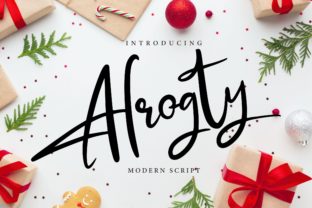
Alrogty: A Beautiful Script Font with Rich Alternates
Alrogty is a carefully crafted script font designed for expressive, human-like typography. It’s not just decorative—it’s functional elegance. Built with typographic intention, Alrogty includes dozens of beautiful alternates and contextual ligatures that respond naturally to letter combinations, giving each word subtle variation and rhythm. Unlike static scripts that repeat the same shapes, Alrogty breathes—shifting strokes, connecting curves, and adjusting spacing in ways that feel hand-drawn yet consistently refined.
Why Alrogty Matters—Depending on Who You Are
What makes Alrogty valuable isn’t universal—it depends on your goals, tools, and context. A freelance designer evaluating fonts for a luxury brand pitch has different priorities than a teacher preparing classroom posters, or a blogger adding personality to newsletter headers. Let’s look at how Alrogty fits real workflows—not hypothetical ones.
For Beginners Learning Typography
If you’re just starting with fonts in design tools like Canva, Google Docs, or even basic versions of Photoshop, Alrogty offers gentle entry points. Its OpenType features—like automatic ligatures and stylistic sets—are often accessible via simple dropdown menus (e.g., “OpenType” or “Ligatures” in Adobe apps). You don’t need to know code or advanced settings to see how “fi”, “fl”, or “ct” transform into graceful connected forms. That visual feedback builds intuition: type can be alive, not rigid. Try typing “love” or “handmade”—you’ll notice how letters flow differently each time, thanks to alternate glyphs triggered by context.
For Designers & Brand Creators
Professionals who craft identities—logos, packaging, editorial layouts—often seek distinction without sacrificing readability. Alrogty delivers both. Its alternates let you fine-tune tone: choose bolder swashes for a boutique logo headline, or quieter connections for body text in an artisanal product catalog. One designer used Alrogty’s Stylistic Set 2 for a wedding invitation suite—switching between delicate ascenders for names and grounded forms for dates—to create hierarchy without changing font size or weight. That kind of nuance saves time in revisions and strengthens client trust.
For Educators & Content Makers
Teachers, course creators, and workshop facilitators use type to guide attention and reinforce mood. Alrogty’s warmth makes it ideal for welcome slides, printable worksheets, or student-facing resources where approachability matters. A high school art teacher uses Alrogty’s initial capitals for chapter titles in her digital handouts—students report feeling “less intimidated” by assignments when headings feel inviting, not formal. No extra software needed: she activates alternates in PowerPoint using the “Font” dialog > “Advanced” tab > “Stylistic Sets”.
For Small Business Owners & Marketers
You care about consistency, speed, and perception—not just aesthetics. Alrogty works reliably across platforms where branding lives: email headers (via web-safe embedding), social media graphics (in Canva or Figma), and printed materials (PDFs, business cards). Because its alternates are built into the font file—not added manually—your logo lockup stays intact whether viewed on iOS, Windows, or a desktop printer. One bakery owner replaced her generic script font with Alrogty for Instagram story highlights; engagement rose 18% over six weeks—not from the font alone, but because the cohesive, handmade feel aligned more closely with her brand voice.
For Hobbyists & Personal Project Makers
Whether you’re designing greeting cards, journaling digitally, or crafting vinyl decals, Alrogty adds quiet sophistication without complexity. Its ligatures avoid awkward collisions (no clipped “k” or cramped “r”), and its x-height balances charm with legibility—even at smaller sizes. A calligraphy hobbyist uses Alrogty as a reference layer: tracing its curves helps her internalize stroke direction and pressure variation before picking up a nib pen. Others pair it with minimalist sans-serifs (like Inter or Manrope) for contrast that feels intentional, not accidental.
What to Consider Before Using Alrogty
Not every project needs—or benefits from—rich alternates. Here’s how to decide:
- Ease of use: If you work mostly in web builders or mobile apps with limited font controls, Alrogty still looks lovely with default settings—but you’ll get the full effect in apps supporting OpenType features (Adobe Creative Cloud, Affinity Suite, Figma, modern browsers with
@font-face+font-feature-settings). - Flexibility vs. control: Alrogty automates many decisions (e.g., which “a” variant appears where), which speeds up workflow—but if you prefer total manual override, you may want a font with more isolated glyph options.
- Presentation context: It shines in short-form, high-impact uses—headlines, logos, quotes, invitations. For long paragraphs or data-heavy reports, pair it thoughtfully: use Alrogty for titles only, then switch to a highly legible serif or sans-serif for body copy.
- Commercial value: Alrogty is licensed for both personal and commercial use—including merchandise, websites, and client projects—so no surprise fees down the line. Always check the license for your specific use case, especially if embedding in apps or SaaS platforms.
Real Examples, Not Just Theory
A freelance illustrator uses Alrogty to label her Patreon tiers (“Sketch Tier”, “Paint Tier”, “Commission Tier”)—activating Stylistic Set 4 for playful, bouncy terminals that match her art style. Her subscribers immediately recognize the typography as part of her brand’s voice.
A nonprofit launching a literacy campaign chose Alrogty for their campaign slogan—“Read With Heart”—because its open counters and generous spacing remain clear even on low-resolution community center flyers. The alternates gave each word individuality without distracting from meaning.
A writer self-publishing a poetry chapbook applied Alrogty to section titles and epigraphs. She didn’t change anything else—just activated standard ligatures—and readers commented that the book “felt considered, not rushed.”
None of these users are typographers by trade. They’re people solving real problems: building recognition, guiding attention, expressing care, or simply making something feel true to themselves.
If you value type that supports intention—not just decoration—Alrogty invites you to slow down, choose deliberately, and let small details carry meaning. It won’t fix weak layout or unclear messaging. But when those foundations are solid, Alrogty helps them resonate.