Southern Hills Font: A Practical Evaluation for Designers and Creators
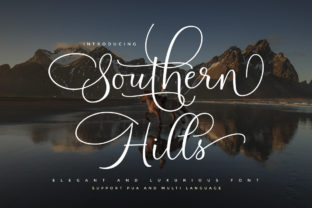
Southern Hills is a sweet and charming handwritten font designed to evoke warmth, approachability, and personal expression. It features flowing letterforms with subtle variations in stroke weight, gentle curves, and consistent baseline rhythm—hallmarks of natural penmanship. Unlike calligraphic or brush-script fonts that emphasize dramatic contrast or texture, Southern Hills prioritizes legibility and cohesion at moderate sizes, making it suitable for both display and short-body applications when used intentionally.
Why Consider Southern Hills?
Designers and creators often seek typefaces that reinforce tone without overwhelming content. Southern Hills appeals to those working on projects where authenticity, friendliness, or handmade character matters—such as wedding stationery, boutique packaging, social media graphics, small-business branding, or illustrated book covers. Its personality sits between formal script and casual handwriting: refined enough for polished use, yet relaxed enough to avoid stiffness.
Interest in Southern Hills typically arises from specific creative goals—not just aesthetic preference. For example, someone developing a brand identity for a local bakery, a children’s illustrator sourcing expressive typography, or an event planner designing custom invitations may evaluate Southern Hills alongside other handwritten options based on how well it supports messaging, audience perception, and production constraints.
Key Benefits and Real-World Utility
Legibility at moderate scale: Southern Hills maintains clarity in headings and short phrases up to 36–48 pt, especially when set with appropriate letter spacing and line height. This makes it more versatile than highly decorative scripts that blur or lose distinction at smaller sizes.
Consistent rhythm and spacing: The font includes carefully tuned kerning pairs and uniform x-height, reducing the need for manual adjustments in layout software. That consistency saves time during design iteration—particularly valuable for non-typographers or teams managing frequent asset updates.
Character set coverage: Most commercial versions include standard Latin characters, numerals, basic punctuation, and common accented letters (e.g., é, ñ, ü). While it does not support extended language scripts or advanced OpenType features like stylistic alternates or swashes, its coverage meets baseline needs for English-dominant projects targeting North American or Western European audiences.
Tradeoffs and Important Considerations
Southern Hills is not optimized for long-form text. Its connected letterforms and variable stroke modulation reduce readability in paragraphs, especially at smaller sizes or on low-resolution screens. Using it for body copy—such as website articles, product descriptions, or multi-page brochures—is discouraged without pairing it with a highly legible sans serif or serif companion.
Its stylistic consistency also means limited visual flexibility. Unlike variable fonts or families with multiple weights and widths, Southern Hills is typically offered as a single weight and style. That limits typographic hierarchy options within a single font file. Designers needing bold emphasis or condensed variants must rely on pairing strategies rather than built-in alternatives.
Licensing is another practical factor. Southern Hills is available through reputable foundries and marketplaces, but usage rights vary by vendor. Some licenses permit web embedding with pageview limits; others restrict use to desktop applications only. Always verify license terms before committing to a project—especially for client work or digital products with ongoing distribution.
When Southern Hills Is a Strong Fit
Southern Hills works well in contexts where emotional resonance and human-centered tone are priorities—and where text volume remains controlled. Examples include:
- Logo lockups or wordmarks for lifestyle brands, artisanal services, or wellness practices
- Invitations, thank-you cards, and gift tags where tactile or personalized feel enhances perceived value
- Social media visuals—especially Instagram carousels or Pinterest pins—with headline text under 20 words
- Book titles or chapter headings in illustrated nonfiction or memoirs aimed at general readers
- Product labels or packaging for small-batch goods where craftsmanship is part of the brand story
In each case, success depends less on the font alone and more on thoughtful implementation: sufficient contrast against backgrounds, adequate spacing, and intentional pairing with neutral supporting type.
When Alternatives May Be More Appropriate
If your project requires extended reading—such as blog posts, e-commerce product pages, or internal documentation—prioritize highly legible, screen-tested typefaces. Even with Southern Hills as a headline font, pairing it with a robust text face (e.g., Inter, Lora, or Source Sans Pro) becomes essential. In such cases, evaluating the entire typographic system—not just the display font—is critical.
For multilingual content beyond basic accented characters, consider fonts with broader Unicode coverage, such as Quicksand (for friendly sans serif), Playfair Display (for elegant serif contrast), or dedicated handwriting fonts like Amatic SC (with wider language support).
If dynamic typographic expression is needed—like responsive weight shifts or contextual ligatures—Southern Hills won’t meet those technical requirements. Variable fonts or families with extensive optical sizing (e.g., GT America, IBM Plex) offer greater adaptability across devices and use cases.
Making an Informed Decision
Evaluating Southern Hills should begin with clear project criteria: What role will typography play? Who is the audience? Where and how will the text appear? Answering these helps determine whether its strengths align with actual needs—or whether its limitations introduce unnecessary complexity.
A practical step is to test Southern Hills in context. Import it into your design tool and simulate real usage: set a headline alongside body text, preview on mobile, check color contrast ratios, and assess rendering across browsers. Compare side-by-side with two or three alternatives using identical content and layout. Note where Southern Hills enhances clarity or mood—and where it creates friction (e.g., inconsistent spacing, poor screen rendering, or licensing ambiguity).
Also consider workflow implications. If your team uses collaborative design platforms or automated publishing tools, confirm compatibility with those systems. Some handwritten fonts trigger rendering inconsistencies in certain PDF generators or CMS editors—issues best identified early.
Finally, remember that typography serves communication—not decoration. Southern Hills can reinforce sincerity and warmth, but only if deployed with purpose and restraint. Its value emerges not from novelty, but from alignment with voice, audience, and medium.